
The 2026 Guide to Building a Luxury eLearning Course
In 2026, the eLearning course is the most complete way for HQ to transfer product knowledge, brand storytelling, and selling standards to retail teams because it’s structured, trackable, and easy to deploy at scale across countries and store networks.
Courses also work because they can be “declined” into modules, then lessons, then short checks (quizzes, challenges, mini-scenarios), which fits the reality of deskless teams with fragmented attention and limited time.
For luxury retail specifically, the bar is higher: training must be premium in visuals and tone, fast to consume on mobile, and immediately applicable in-store. The course needs to leave no gaps in the critical arguments (materials, craftsmanship, positioning, objections, cross-sell logic), but it must also push a spirit of action: “I can use this with a client today.”
A high-performing structure that keeps completion high in 2026:
Course → Modules → Lessons → Quizzes/Challenges → Award or Certification
This creates a clear finish line and a measurable standard for HQ, while giving store teams a motivating outcome.
A creative eLearning agency doesn’t “upload content.” It translates raw HQ information into a learning experience that earns attention and builds confidence—using premium storytelling, strong UX, and interactive formats.
What this means in practice:
The same information can be delivered in multiple formats (video, audio, interactive cards, widgets, quizzes) so Sales Advisors can access it quickly depending on the situation.
Some content is designed for learning; some is designed for in-the-moment use (quick refresh before a client appointment, product details during downtime, service language reminders).
The course becomes a trainer’s tool: it transforms information into behavior, not just knowledge.
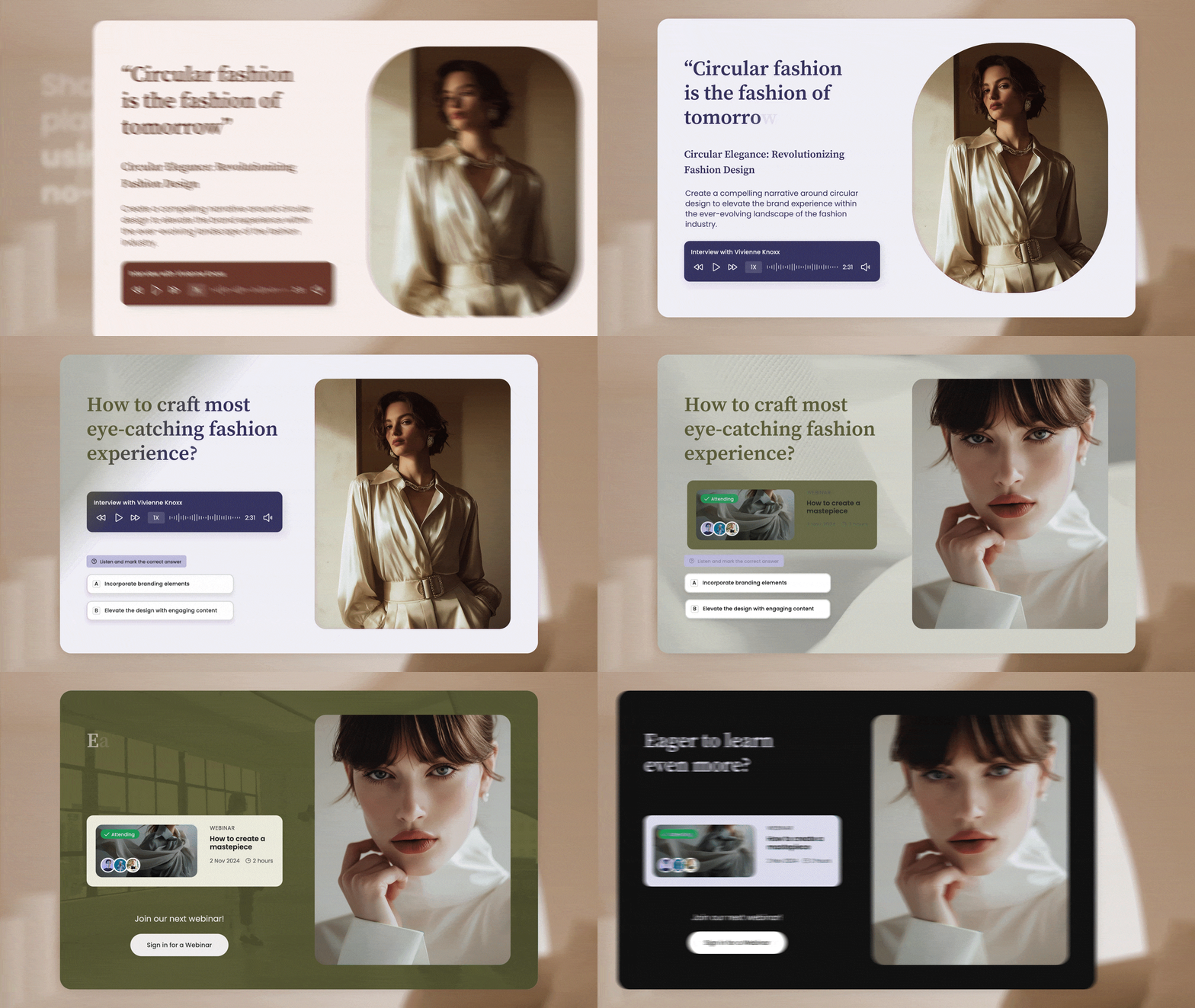
The 2026 new standard for eLearning course retention
Retention in 2026 is not “they watched it once.” Retention means Sales Advisors can recall, apply, and repeat the right behaviors over time and the learning stays alive during the full lifecycle of a product launch.
Think in terms of the perfect outcome:
Sales Advisors feel confident explaining the new capsule with the right vocabulary and emotional story.
They can answer client questions without hesitation and handle objections in a brand-consistent way.
They can use short assets from the app to support a conversation (refresh materials, references, features, care tips).
To make this measurable, define success data (KPI's) from day one:
Learning data: completion rate, quiz score distribution, time-to-complete, replay rate on key lessons.
In-store signals: manager observation checklist, morning briefing feedback, clienteling usage.

From HQ brief to store performance
This blueprint is designed for luxury retail realities: short attention, limited training time, and high performance expectations.
Start from the performance outcome
Instead of “This course is about the new collection,” define the outcome like:
“After this course, Sales Advisors can present the 3 hero pieces, explain craftsmanship in 60 seconds, and handle the top 5 objections while maintaining the Maison tone.”
Common luxury retail training objectives:
A new product launch or hero SKU focus.
A capsule collection drop with a specific commercial priority.
New craftsmanship/production methods that elevate perceived value.
An icon piece refresh (history, details, styling, client questions).
A marketing campaign push that must translate into store language.
Then make it instantly clear for learners:
What they’ll be able to do.
Where they’ll use it in the client journey.
How success will be measured (learning + store impact).
When the outcome is written in “on-the-floor language,” the rest of the course design becomes easy to prioritize: only the arguments that truly help Sales Advisors sell with confidence stay in, and everything else becomes optional reference material. This is also the moment to define the success signals upfront (completion, score, confidence pulse, manager observation, and product/category KPIs), so HQ and stores share the same definition of “training worked”, not just “training was delivered.”
2. Turn knowledge into scenarios that feel real
Scenarios are where luxury training stops being informational and becomes usable. In 2026, the most effective courses don’t teach “what the product is,” they teach “how to bring it to life in a client conversation” with the right tone, rhythm, and emotional cues. Build scenarios around the real boutique journey: greeting and discovery, storytelling and demonstration, fitting room moments, gifting and wrapping, care and after-sales, and the delicate conversations (waiting lists, pricing, availability, repairs). Each scenario should answer: what does the client say, what does the advisor do, what does the brand expect, and what’s the best next move?
High-performing scenario formats:
Premium short videos: the client conversation, tone, pacing, objections.
Audio coaching: how to say it (service language, confidence, pronunciation).
Interactive branching: “choose your next move” clienteling dialogues.
Visual product anatomy: hotspots, material callouts, 360 views.
InstaLearning: fast learning moment designed for everyday use (15–45 second micro cards) with one key fact + one client sentence + one product detail. Perfect for quick refresh before a client appointment, or during quiet store moments.
To keep content premium and practical, mix formats intentionally. Use short video for body language and tone, audio coaching for vocabulary and pronunciation, interactive branching for decision-making, and visual product anatomy (hotspots, close-ups, 360 views) for detail mastery. Add InstaLearning as the “instant recall layer”: 15–45 second micro-cards with one key fact, one client sentence, and one product detail to reiterate the concept before an appointment or between clients.
The best scenario design also anticipates objections: price, comparison, durability, materials, “what makes it special,” and “why now.” When scenarios mirror reality, Sales Advisors don’t feel like they’re studying, they feel like they’re rehearsing performance.
3. Make practice a daily learning habit
Practice is where knowledge becomes skill. In 2026, practice is not only “a quiz at the end,” it’s a daily rhythm that keeps teams connected to launches, updates, and best practices.
Digital practice that keeps engagement high:
Quizzes that train decisions, not memory (best next step, what to say next, what to show).
Gamified challenges tied to launches (missions, streaks, skill paths).
Scenario replays: same client profile, different needs, new constraints.
Offline practice that makes it stick:
Peer roleplays during morning briefings.
Product handling drills (30s pitch, 90s story, 3 minute full narrative).
Manager coaching moments with a simple checklist.
The app should become the place where new information is shared continuously, so everyday access builds a real learning culture (not “training season” twice a year).
Practice becomes powerful when it’s frequent, lightweight, and connected to real launches. Daily mini-challenges, quick scenario replays, and peer roleplays turn the platform into a living learning space where teams don’t only “finish a course,” they keep sharpening skills as the season evolves.
4. Coaching and feedback loops
Assessment shouldn’t feel like school. In luxury retail, feedback works best when it supports confidence and consistency.
Feedback is the engine that transforms training into a culture. In luxury retail, in-person coaching remains the gold standard because tone, posture, phrasing, and confidence are best corrected live fast, human, and contextual. But the platform can multiply that coaching impact by making feedback easier to capture, revisit, and share consistently across stores.
A modern feedback system uses two channels:
In-person coaching: fast, human, immediate, best for tone and service behaviors.
Platform feedback: scalable, trackable, and easy to share for both parties.
How to do platform feedback well:
Comments inside learning modules for Q&A on specific points.
Community chat for peer tips and “what worked in store” sharing.
Quick confidence polls to identify who needs coaching.
Use two complementary layers and close the loop:
Micro-feedback inside modules: comments for Q&A “How do we explain this material difference?”, manager notes on scenario outcomes, and reflection prompts that encourage self-correction.
Community feedback: a moderated chat where advisors share what worked, how they handled a real objection, or how they positioned a hero piece without discounting. Add quick confidence polls to spot who needs support before performance drops.
Close the loop: when a recurring questions appear, update the course (or add an InstaLearning card) so the content evolves with store reality.
A feedback loop is not an evaluation system, it’s a performance support system. When learners see their questions improving the training, engagement rises because the platform feels “alive” and relevant.
5. Reinforcement to alive the course
Reinforcement is the best retention strategy. Without it, even a premium course becomes a one-time event, and knowledge decays quickly, especially during busy retail periods. The goal is to keep the same topic accessible in new angles, new formats, and new moments across the season.
Plan reinforcement like a product calendar. After launch week, push one high-value reminder at a time: a micro-challenge on objections, a “one-minute story” refresh, a visual detail card, or a short manager coaching prompt. Use weekly InstaLearning drops to keep vocabulary sharp and maintain product focus without overwhelming teams. Refresh scenarios based on what stores are actually hearing: if a new objection appears, create a new branch in the dialogue. Add micro-certifications aligned to campaign phases (pre-launch, launch, post-launch) so learners have a reason to come back and prove mastery again.
Reinforcement ideas that work in luxury retail:
Push notifications that deliver value: one tip, one micro challenge, one refresh.
Weekly InstaLearning drops on the same topic in a new angle.
Updated scenarios based on real objections heard in stores.
Micro-certifications for new drops or campaign phases (points or awards).
Reinforcement is also where HQ builds trust: updates show that training isn’t static, and that the brand is listening to the field. When reinforcement is done well, the course becomes a living asset that supports selling excellence throughout the entire product lifecycle.
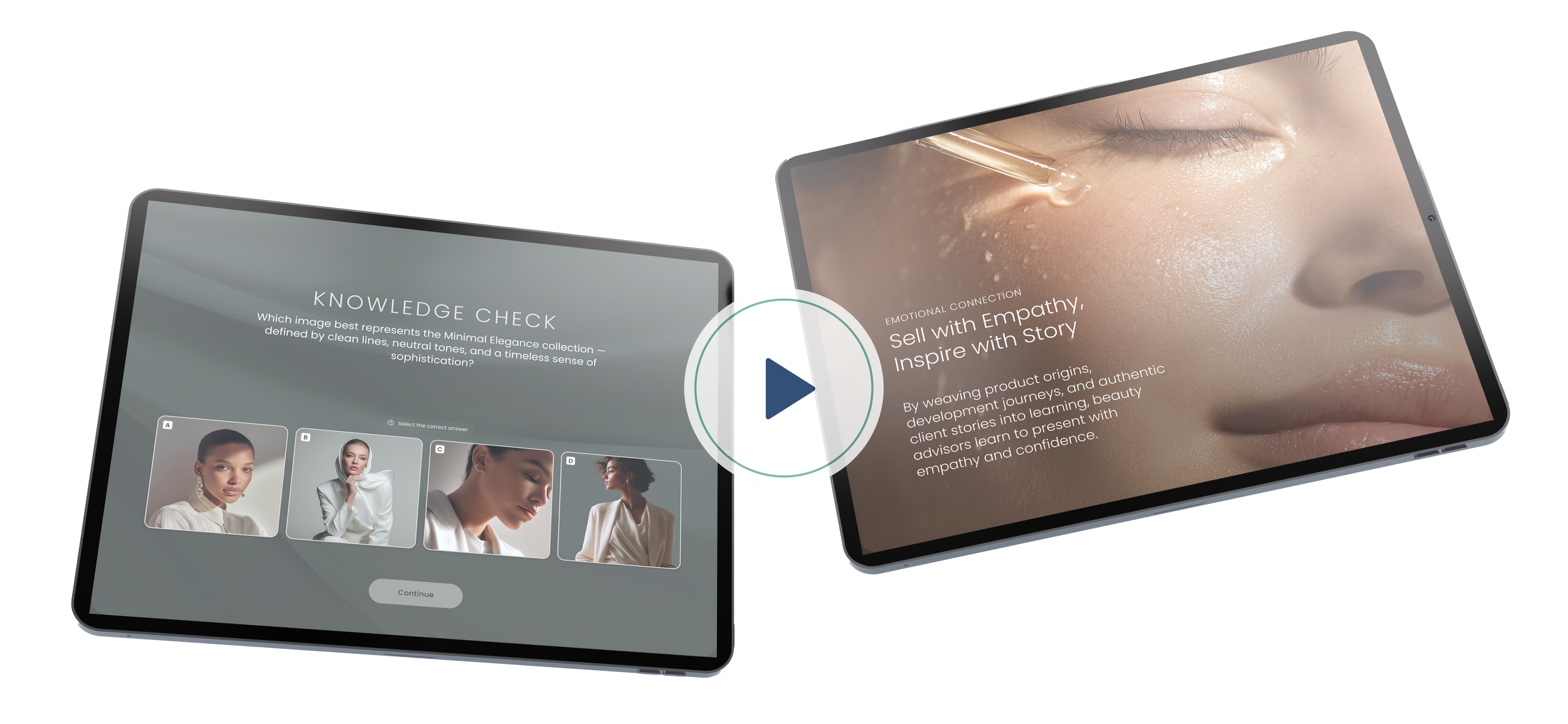
The Winning elearning training path to follow
A luxury retail eLearning course in 2026 wins when it behaves like a premium client experience: it is clear, curated, immersive, and designed to drive confident action and not passive consumption. The best courses start with a performance outcome that Sales Advisors can feel instantly: “I know what to say, what to show, and how to handle the moment.” From there, the structure becomes a strategic journey: modules and lessons that build clarity, quizzes and challenges that shape decisions, and a certification path that signals mastery and gives HQ a consistent benchmark across stores.
What truly separates an average course from a high-performing one is the realism of its scenarios. When learning is built around client “ready moments” discovery, fitting room conversations, gifting, care, after-sales, and objections advisors don’t memorize facts, they rehearse excellence. Add InstaLearning to make knowledge “pocket-sized” and accessible on demand, and suddenly training becomes something teams use daily, not something they complete once.
Finally, retention is not a finish line, it’s a system. Continuous practice creates habit. Coaching and feedback loops create culture. Reinforcement keeps the content alive across the season with timely updates, micro-challenges, and new angles that match what is happening on the floor. Track success from day one using learning metrics (completion, score, replays), operational signals (manager checklists, confidence pulses), and business proxies (sell-through, conversion, attachment rate) to prove impact and improve fast.
When a course is built like a living product premium, practical, measurable, and continuously refreshed it becomes one of the strongest tools HQ can use to empower Sales Advisors, protect brand standards, and turn every launch into store performance.
