
8 Ways to Foster Retail Training Engagement in App.
Create a healthy community to foster eLearning, retention, and sales impact.
Engagement in retail learning is not a “content problem” alone. It is a culture and habit problem. If training feels like school (formal announcements, long modules, and the pressure to “study for exams”), people will postpone it until the last minute, rush through it, or avoid it entirely.
A retail training app should feel closer to daily store life: quick, useful, social, and connected to real selling moments.
The strongest driver of sustained engagement is a healthy community inside (and around) the app: people who share tips, celebrate wins, ask questions without fear, and learn together. Well-designed ambassador programs and store-led rituals can make learning feel like belonging, not compliance, and that belonging is what keeps learners coming back. Social learning design also works best when it has a clear purpose, is co-created with early adopters, and includes visible recognition for participation.

Start with purpose, not modules
A common failure mode is launching an app full of content, then “pushing communications” and hoping usage follows.
Engagement starts when learners understand why the space exists and what is in it for them, today, on the floor, with clients.
A healthy learning community needs clarity: what problems does it solve (product confidence, selling consistency, clienteling), and how participation helps both the individual and the store.
When purpose is clear and value is obvious, participation becomes natural. Without value, learners disengage.
Driving engagement through:
Weekly communications from the brand itself (campaign launches, appearance in magazines, collaborations).
New content, seasonal launches, capsules, new courses on the selling ceremony, and updates.
Community interactions: sales advisors participating in challenges and store actions suggested by the training team.
Direct communications: performance teams and store operations teams can directly share updates on back-of-house activities, performance, and marketing calendar updates.
Treat the app as a performance tool with a community layer, not as a mobile library. Engagement rises when the platform has a purpose people can feel in their daily work, not just a catalog they are told to finish.
2. Design onboarding as a beautiful journey
New sales advisors do not need everything at once.
They need the right things in the right order. A digital onboarding path inside the app reduces anxiety, creates early wins, and helps new hires become productive faster, without overwhelming them.
Break onboarding into short stages: brand codes, service rituals, product foundations, selling ceremony basics, then role-specific deep dives. Spaced practice over time improves long-term retention compared to cramming, so onboarding should drip and repeat key ideas rather than delivering them once.
A well-executed onboarding:
Day 1–3: Welcome and brand culture” in a 10-minute module, then practice with the store staff.
Week 1: Introduction to the product eLearning content” with modules on seasonal products and icons.
Week 2: The selling ceremony.” A guide on how the Maison expects you to sell its creations.
Week 3: Maintaining the learning culture” through active participation in community gamification and store activities.
Onboarding should feel like getting stronger each day, not surviving an information flood. A staged journey builds confidence, and the app becomes the place new hires go to feel ready, not judged.
3. Make content understandable for everyone
Retail teams are diverse: different tenure, languages, education levels, and confidence with digital tools.
Engagement drops when content feels too corporate, too complex, or disconnected from reality. The best retail LMS content is tailor-made, short, visual, and immediately applicable.
Microlearning works when it respects attention and time, and when it is designed for repeated, spaced review rather than one-and-done consumption. This approach aligns with evidence that spaced retrieval improves long-term retention, especially when practice is repeated over time.
Golden rules to create a microlearning module:
1 idea per screen: 1 skill per module, 1 clear takeaway.
Visual product maps: materials, key differentiators, “how to explain it”.
“Client language” glossary: how to translate technical features into benefits.
Accessibility basics: subtitles, clear typography, audio-friendly modules.
Content that is “beautiful but unclear” is still ineffective. Comprehensible content respects learners, reduces friction, and creates the steady progress that fuels daily engagement.
4. Refresh seasons and icons with “newness” that feels collectible
Retail engagement thrives on freshness.
If the app looks the same week after week, it becomes background noise. Build a rhythm: seasonal drops, campaign storytelling, icon refreshers, and “what’s new this week” highlights.
This is where luxury has an advantage: storytelling is already part of the brand. Turn that storytelling into short modules and community prompts, and learning starts to feel like staying current in the Maison, not attending school.
A few suggestions for training-led content:
Monthly “Icon Spotlight”: one hero product, one story, one skill, one quiz.
Seasonal “Style and service updates”: how to present new colors and materials.
Seasonal quiz: questions posed every week about the seasonal products.
Relevance is perishable. When the app continually updates what matters now, learners come back because it protects their confidence on the floor today, not because they were told to.
5. Gamify participation, not just completion
Gamification is not about turning luxury into a cartoon.
It is about making progress visible and participation rewarding.
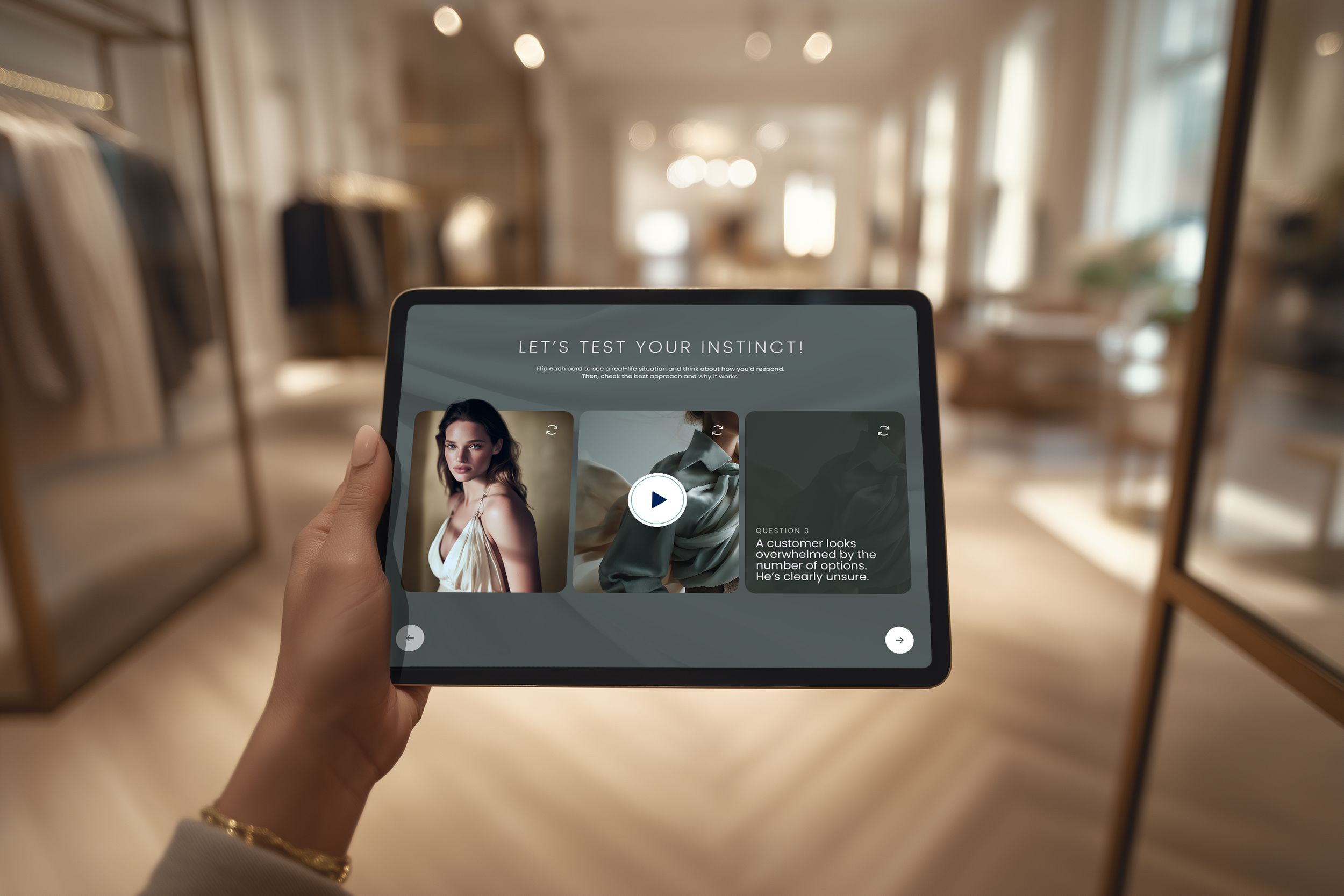
Points, levels, badges, and challenges work especially well when tied to meaningful behaviors: practicing scenarios, sharing tips, completing seasonal refreshers, or contributing client-safe storytelling lines. Retail-focused gamification commonly uses mechanics like leaderboards, levels, rewards, and team competition to increase engagement and motivate participation.
Points for daily microlearning streaks and scenario practice.
Badges for mastery (materials expert, care expert, icon specialist).
Recognition that feels luxury: curated experiences, access, visibility, not “cheap prizes.”
The goal is not to “game” learning. It is to build a habit. Gamification gives learners a reason to return, and repetition is what turns training into real sales-floor fluency.
6. Create a community game
Store vs store, region vs region, and user-to-user
To drive daily return, build an original game that lives both on and off the floor, but is digitally shared through the LMS.
The game should encourage friendly competition, teamwork, and consistent participation, with weekly or monthly cycles to keep momentum.
Gamified programs often leverage visible progress and prizes to make participation feel rewarding and social, helping sustain engagement over time.
A few suggestions for community-led content:
Weekly challenge: ideal client personalization to foster cross-selling.
Monhtly sharing: recorded storytelling rehearsals.
App formats: games that have individual leagues, store leagues, regional championships.
Retail is already a team sport. When learning becomes a shared game with rules, cycles, and celebration, engagement stops being a personal burden and becomes a store culture.
7. Track data, use leaderboards wisely, and reward effort
If you gamify, you must measure.
Tracking learning data (participation, completion, accuracy, repeat practice) lets you refine content, identify gaps, and keep competition credible. A leaderboard can motivate, but only if it is fair, transparent, and designed to encourage improvement rather than shame.
Effective gamification commonly includes leaderboards and rewards to recognize high performers, motivate others, and create healthy competition.
Separate Social learning from sales results: reward training behaviors you control.
Weekly resets or seasonal competitions: so newcomers can compete.
Real prizes for real effort: certifications, events, product previews, mentorship access.
What gets measured gets managed, and what gets celebrated gets repeated.
When data and recognition are built into the app, engagement becomes self-reinforcing and leaders can coach with precision, not assumptions.
8. Activate ambassadors to scale culture beyond HQ reach
No central team can cover every store every week.
Store ambassadors solve this by creating local energy: they welcome new hires, animate challenges, collect feedback, and keep the learning community alive in each door.
Ambassador programs work best when participation is visible, supported by structure, and recognized, often with incentives that make contribution rewarding.
Developing an ambassador strategy:
1 ambassador per store (or per cluster), with a monthly feedback call with the training team and store managers.
Ambassador content drops: facilitation tips, early previews, Q&A packs.
Community rituals: “tip of the week,” “best client phrase,” “win story.”
Feedback loop: ambassadors flag content gaps and client questions to HQ.
Ambassadors turn your training strategy into a living network. They help the brand stay close to the floor, and they make learning feel like something “we do here,” not something “they send us.”

Turn your app into a daily retail habit
Keeping learners engaged in a retail training app requires more than content uploads and official communications.
The recipe is a healthy community with a clear purpose, a staged digital onboarding journey, understandable tailor-made microcontent, seasonal and icon refreshes that keep the platform relevant, and gamification that makes participation addictive in a good way. Spaced practice and repeated retrieval turn “training done” into real retention, while leaderboards, data, and fair rewards create momentum that stores can feel week after week.
Most importantly, ambassadors and store-led rituals scale your learning culture into every door, including those HQ cannot reach consistently. When learning feels social, useful, and rewarding, advisors return daily, and daily return is what drives fluency, confidence, and ultimately better selling behaviors.
To build this kind of engagement engine, develop a learning strategy with Penceo Content Agency: from onboarding journeys to icon storytelling, from community game design to premium retail microlearning that advisors actually want to open every day.
