
Watch Retail Training That Builds Confidence
A luxury retail playbook for product precision, storytelling mastery, and client experience consistency.
High value watches are not sold like accessories. They are sold like heritage, mastery, and membership. A client is not only choosing a model. They are choosing a story they want to wear, a craft they want to trust, and a value they want to keep. In a single appointment, you may speak about finishing, materials, complications, servicing timelines, and provenance, then switch tone to emotion: identity, milestones, gifting, legacy. That is why watch retail training is uniquely demanding. It must be technically accurate, emotionally intelligent, and delivered with calm authority.
The product itself raises the stakes. Watches are technical objects with real engineering complexity, but they are also symbolic objects. Different models speak to different people: the collector who cares about detail and history, the first-time buyer who needs reassurance, the client celebrating a life moment, the gift buyer who wants certainty, the client comparing investment value, or the client who wants discretion more than explanation. One brand story can be true, but it must be adapted to the person in front of you.
This is why training cannot be a single long course that lives in a library.
Retail time is fragmented, clients arrive unpredictably, and teams need support that fits real store rhythms. Penceo frames this reality clearly in its retail learning approach: time on the floor is fragmented, and training works best when it is delivered in small, focused formats that match those micro-moments, with nano learning for one precise rule or phrase and microlearning for short sequences that need practice. Their product launch guidance also highlights a crucial truth for luxury selling: advisors are not trying to know everything, they are trying to respond confidently to the next client question and keep the selling ceremony smooth.
A strong watch retail training strategy builds that confidence systematically. First, it defines what precision really means and how to prove value without overwhelming. Then it creates the right “widgets” for learning: comparison tools, micro video, and scenario practice. Finally, it reinforces the selling ceremony through etiquette, pronunciation, coaching, and feedback loops that connect training to measurable performance.
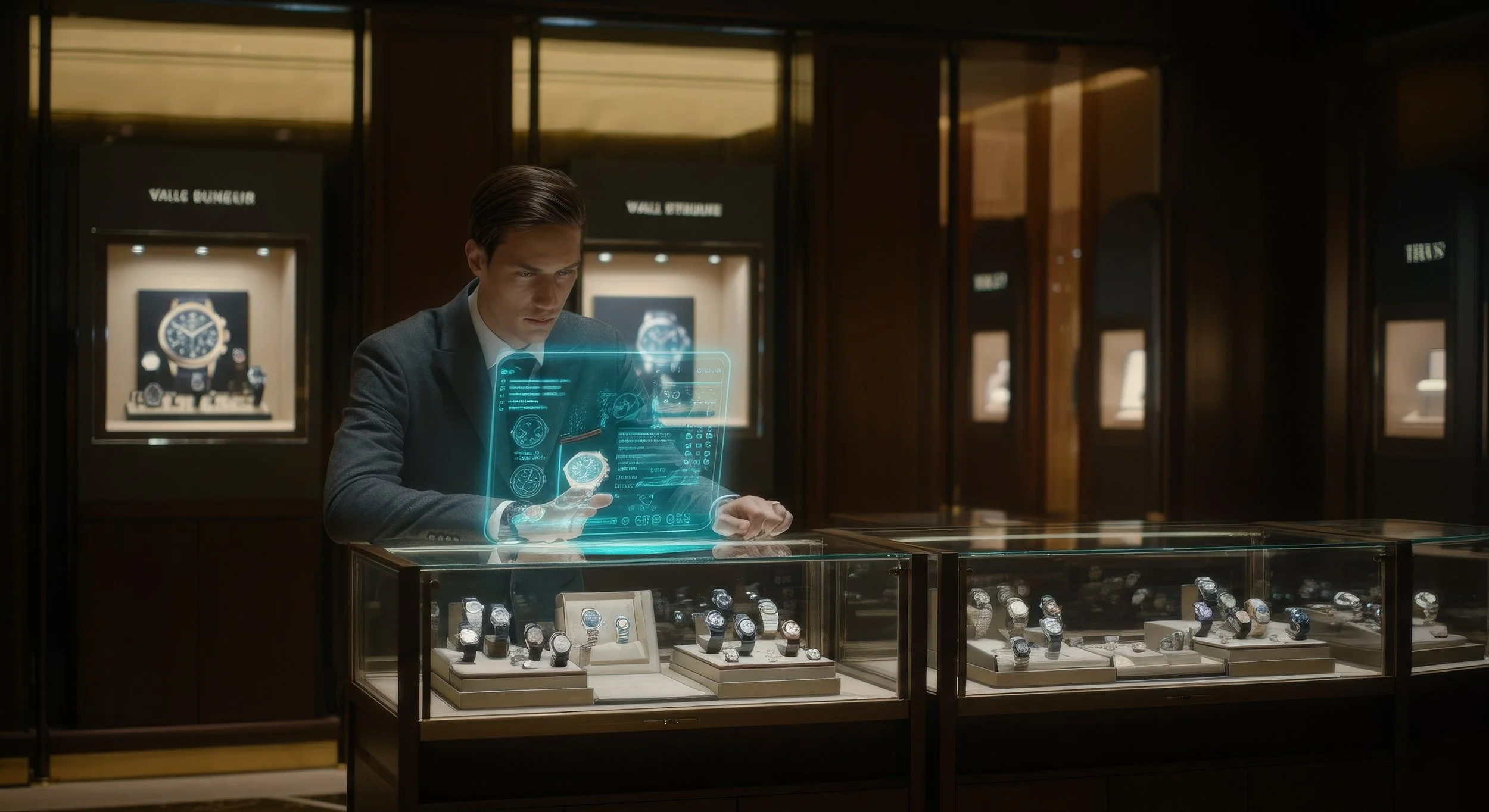
Watch Retail Training Strategy for Technical Products
Precision, proof, and calm confidence
Technical luxury training fails when it treats specs as the goal. Specs are only useful when they become proof in a client conversation.
A precision-first strategy starts by defining what your teams must be able to do:
Explain one technical element accurately in plain language.
Connect that element to a client value such as durability, comfort, rarity, serviceability, or identity.
Stop at the right moment, leaving space for the client to react.
In practice, precision is not “more facts.” It is fewer facts delivered with more control.
What to build into the content
A short “fact integrity” layer that prevents errors and brand risk.
A proof hierarchy: what to say first, what to keep for follow-up, what never to guess.
A confidence rule: if unsure, how to respond without breaking trust.
In watch retail, the fastest path to credibility is accurate restraint. Training should teach teams how to be precise without turning the interaction into a lecture.
Product Storytelling for Watches That Feels Like Luxury
Heritage, craft, and emotion, without sounding rehearsed.
Luxury storytelling is not about adding drama. It is about revealing meaning. The goal is to help the client feel they are buying something with depth, not something with a list of features.
Penceo’s own launch approach emphasizes that what matters is telling a consistent story with enough flexibility to feel personal. That is the watch challenge in one line: consistent narrative, personal delivery.
A simple watch storytelling structure that works
Heritage anchor: one sentence that places the model inside the maison story.
Craft detail: one observable detail that signals mastery.
Client relevance: one reason this matters for this person.
Invitation: a question that moves from speech to discovery.
Content creation tips
Write stories for spoken delivery in 30 to 45 seconds.
Include two variations by client profile: collector and first-time buyer.
Provide “gold lines” that are elegant and natural, not marketing slogans.
Storytelling becomes powerful when it protects the brand’s codes and still lets the advisor sound like a human. The objective is not memorization, it is presence.
The Importance of Building Proof
A retail product comparison system for models, materials, and product details.
Clients compare, even when they do not say they are comparing. They compare to last season, to other models, to other brands, and to the version they saw online. If teams cannot compare clearly, the conversation becomes vague and trust drops.
Your training should include a comparison system that is simple, accurate, and consistent across stores.
Three comparison assets to create
Model-to-model card: what is different, who it is for, what to emphasize.
Material and finishing card: what changes feel and durability, what the client can notice.
Servicing and longevity card: what ownership looks like over time, care, warranty, service rhythm.
Penceo’s nano and microlearning guide supports this split well: nano works for one feature or one rule, micro works for storytelling plus comparison in a short sequence.
Comparisons are not “extra knowledge.” They are what turns a watch wall into a guided choice. Great comparisons reduce uncertainty and increase confidence, for both client and advisor.

Watch Retail eLearning Content Formats That Actually Get Used
Micro video, nano refreshers, and instalearning placement.
Your formats must match store reality. If a lesson needs uninterrupted time, it will be postponed. Penceo’s retail guidance is direct: store teams learn in short windows between clients and at the edges of shifts, which is why nano and micro formats have become default.
The core training widgets
Nano lessons: one phrase, one rule, one feature, one warning.
Micro lessons: one coherent skill sequence, such as story plus comparison plus question.
Instalearning placement: make support visible between client moments, not only as a “course.”
Video rules that fit luxury
Keep most clips under 60 seconds.
Always subtitle.
Film hands, finishing, clasp behavior, wrist movement, not only talking heads.
Use calm pacing and silence. Luxury is not rushed.
Watch training formats must be designed like retail tools. The best content is the content that appears at the moment of need and disappears once the advisor is confident.
Scenario-Based Watch Sales Training
Objections, trade-up moments, and ownership questions.
Objection handling is where technical and emotional selling meet. Penceo calls objection handling the launch battlefield and recommends building micro scenarios around real client personas. Watches demand the same.
Build scenario content around the most common watch moments:
Price hesitation and value framing.
Comparison requests and “why this model.”
Authenticity and provenance reassurance.
Service and maintenance questions.
Availability, reservation, and waiting list conversations.
How to write better scenarios
Keep choices plausible. Bad choices teach nothing.
Write consequences in emotional terms: trust rises, trust drops, client relaxes, client withdraws.
Provide the best line and the best move, then let learners replay.
Scenarios convert knowledge into action. They are the bridge between “I learned it” and “I can use it calmly with a client.”
Selling Ceremony and Luxury Etiquette in Watch Retail
Galateo, posture, and the invisible details clients notice.
In watch retail, the ceremony is part of the product. Training must cover not only what to say, but how to present, pace, and handle the object.
Create content that codifies the ceremony:
Presentation sequence: how the watch is introduced, placed, and invited.
Handling etiquette: gloves or cloth protocol, case handling, strap adjustment.
Conversation etiquette: when to speak, when to pause, when to lower volume.
Discretion cues: how to respond when a client signals privacy.
In luxury, etiquette is not formality. It is comfort. A well-trained ceremony makes clients feel safe, respected, and in control.
Pronunciation and Watch Vocabulary Training
Confidence is often lost in one mispronounced term.
Watches involve brand heritage terms, technical vocabulary, and model names that vary across languages. Mispronunciation does not only sound wrong, it can undermine authority.
Build a pronunciation and vocabulary layer:
A short audio library: key terms spoken slowly and naturally.
A glossary with usage examples, not only definitions.
“Do not say” warnings for incorrect or misleading language.
This can be nano learning at its best: one term, one correct pronunciation, one sentence example.
Pronunciation training is a small investment with a huge payoff. It protects credibility instantly, especially for new hires and multilingual teams.
Store Manager Coaching for Watch Retail Excellence
Checks, prompts, and weekly role-play rituals.
Digital training raises exposure. Managers turn it into habits. Penceo’s launch guidance includes manager-led coaching rituals and short role-play moments to validate behavior on the floor.
Manager coaching toolkit
One weekly scenario huddle: 10 minutes max, one objection, one best line.
One observation checklist: greeting, story, comparison, service question handling.
One micro prompt per day: “Ask this discovery question today.”
One debrief question: “Where did you hesitate, and why?”
Coaching is not an extra layer. It is the layer that makes training real. When managers have simple tools, standards become consistent across shifts.
Learner Feedback and Store Questions
Turn client questions into weekly training updates.
The fastest way to keep watch training relevant is to capture the questions clients are actually asking and turn them into short updates. Penceo recommends updating a “Top 5 questions” module frequently during launch week and removing outdated content fast to protect trust.
Practical feedback methods
One-question pulse twice per week: “What question did you get that you could not answer confidently?”
Voice notes from ambassadors.
Manager weekly summary: top objections, top confusion points, top comparison requests.
Feedback is the engine of continuous improvement. When stores see their questions become updated content, adoption rises because training feels like support, not control.
KPIs for Watch Retail Training Success
Measure confidence, consistency, and client experience signals.
The goal is not to prove training exists. The goal is to prove it changes performance.
Penceo suggests performance-focused signals like time to confidence, reduction in repeated errors, manager observation checklists, replay rates, and store feedback. Those translate well to watches.
KPIs that matter
Time to confidence for new hires: how fast they can deliver the hero story and handle top objections.
Reduced repeated errors: fewer incorrect comparisons, fewer uncertain service answers.
Manager validation scores: observation checklist results by week.
Replay rate of key micro videos: relevance and need signal.
Client experience indicators: consistency in service rituals, clarity, reassurance quality.
If you only measure completion, you optimize for completion. If you measure behavior signals, you optimize for client experience.

High-Value Client Relationship and After-Sales Care Training
Ownership is part of the sale.
For watches, after-sales is not a department. It is part of the purchase confidence. Training must prepare teams to speak clearly about ownership and care.
After-sales content to include
Service timeline explanation in simple language.
Care guidance: what to do, what to avoid, how to store.
Warranty clarity: what is covered, what is not, how to proceed.
Follow-up scripts: clienteling messages that feel discreet and premium.
Also include accessories and complements:
Strap options and when to propose them.
Storage and care accessories.
Gift-ready rituals and aftercare handoff moments.
When after-sales is explained calmly and precisely, clients feel protected. That protection increases trust and reduces post-purchase friction.
Watch retail training is a confidence system, not a knowledge dump
Great watch retail training respects the truth of luxury: clients buy heritage, mastery, and belonging as much as they buy a technical object. To sell that responsibly, teams need precision and restraint, a clear proof hierarchy, and storytelling that feels personal without drifting off-brand. They also need tools that match store life: short video, comparison cards, scenario practice, pronunciation support, and instalearning moments that show up exactly when confidence is needed.
A strong program follows a clear structure.
First, it defines what excellence looks like in observable behaviors: the 30-second hero story, the comparison logic, the objection response, the service and after-sales explanation.
Second, it builds training widgets that make those behaviors easy to rehearse.
Third, it reinforces the selling ceremony through etiquette and manager coaching rituals, then improves continuously through store feedback and performance KPIs.
Penceo’s approach to retail learning aligns with this rhythm, emphasizing short formats that fit the fragmented workday, scenario refreshers, visible content governance, and coaching validation on the floor.
