
Nano Learning vs Microlearning for Retail Teams
A practical decision guide to choose the right format for product, service, and sales skills and scale it globally.
Retail training has one brutal constraint: time is fragmented. Store teams learn between clients, during short back-of-house moments, before opening, or in the last minutes of a shift. That’s why nano learning and microlearning have moved from “nice modern formats” to the default architecture for frontline training. Penceo’s own point is straightforward: short lessons fit busy schedules, work well on mobile, and keep engagement high through focused, bite-sized delivery.
But brands often confuse the two. Some call everything “microlearning,” even when the content is 18 minutes long. Others produce ultra-short clips that are entertaining but too shallow to change behavior. The result is predictable: training becomes content consumption, not performance support.
What exactly is nano learning, and what is microlearning?
When should you use which format?
How do you write objectives that truly fit the format?
How do you keep content on-brand and scalable across markets?
How do you measure impact beyond completions?
Nano learning and microlearning are not opposing styles. They are two time windows serving the same discipline, one objective, immediate application, and repeatable reinforcement. They become powerful when you design them as a learning system, not as a pile of clips.
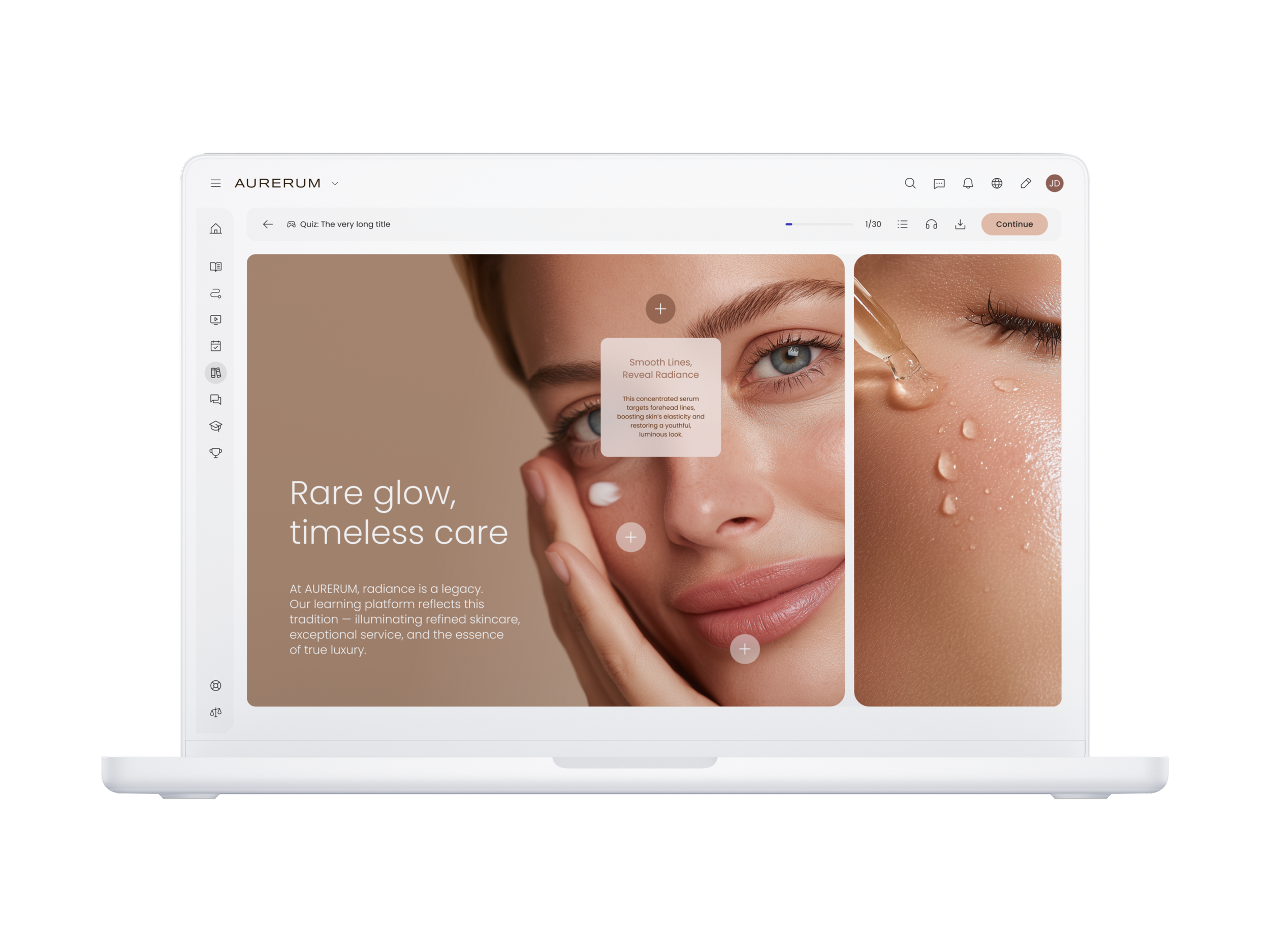
Define the formats without confusion
Nano learning is a “single move.” Microlearning is a “single skill unit.”
Nano learning is the shortest usable unit of learning: a quick insight or instruction delivered in an ultra-short format, often under two minutes, designed for immediate application.
Microlearning is slightly longer, often around 3 to 10 minutes, still focused on one objective, but allowing more explanation, demonstration, and a small practice loop.
The real difference is not only time. It’s the depth of the learning loop you can run.
Nano learning delivers a single rule, phrase, gesture, or feature.
Microlearning delivers one coherent skill unit: a small sequence of actions that must be practiced.
Nano is ideal for just-in-time refreshers and launch updates.
Micro is ideal for onboarding segments, scenario training, and skill-building through short practice.
Both should be designed for mobile-first consumption and fast replay.
Both become much stronger when they are combined with quizzes or short retrieval prompts.
In 2026, the winning format is not “short content.” It is content that respects cognitive load and retail time. Nano learning and microlearning are two tools that let you design for that reality, provided you keep the “one objective” rule intact.
2. The decision matrix by topic type
Product, service, tools, and selling ceremony require different lengths.
A common mistake in retail training is treating all topics equally. Product knowledge, service rituals, POS tool usage, and selling ceremony behaviors do not require the same kind of practice. If you choose the wrong format, you either overload the learner (too long) or under-train them (too short).
Here is a decision matrix you can use in fashion and luxury retail:
Product knowledge: nano for one feature, micro for storytelling plus comparison.
Service rituals: micro for the full sequence, nano for reminders of tone and timing.
POS and clienteling tools: micro for step-by-step walkthroughs, nano for “fixes” and shortcuts.
Selling ceremony: micro for one step (discovery, proposal, closing), nano for key questions and phrases.
Policy updates: nano for “what changed,” micro for scenario-based application and edge cases.
Brand DNA: micro for meaning and narrative, nano for signature vocabulary reinforcement.
What matters here is the number of mental moves required. If the objective requires a sequence, microlearning is safer. If it requires one accurate recall moment, nano learning is perfect.
Retail teams don’t need one perfect 45-minute module. They need dozens of precise moments of support.
Choose nano when the behavior is atomic.
Choose micro when the behavior has steps.
Then sequence them into learning paths tied to the calendar of the business.
3. Writing objectives that fit the format
The craft is narrowing, not adding.
The reason many “microlearning programs” fail is that the content creators never narrowed the learning objective. They wrote an objective like “Understand the new collection,” which is not an objective. It’s a wish.
For nano learning and microlearning, objective quality is everything. A good objective has three properties:
It names a behavior.
It names a context.
It names a proof.
Use this formula:
After this, you can [behavior] in [context] and you will show it by [proof].
Examples:
Nano objective: “Ask one open discovery question to identify a client’s occasion, and capture the answer in one sentence.”
Micro objective: “Run a three-step product story (origin, craft, benefit) and close with a check question.”
Use action verbs: identify, ask, propose, handle, close.
Restrict to one behavior and one scenario.
Add one observable proof: what will the manager see? what will the client feel?
Tie the objective to a store moment: launch day, high traffic, aftercare request.
Decide if the objective needs practice or just accurate recall.
Write the objective in the learner’s language, not the head office language.
Nano and microlearning force clarity. That is not a limitation. It is the reason they work.
A store does not improve because people “covered content.” It improves when people repeat a better behavior consistently.

4. Instalearning in 2026
Nano content becomes powerful when it arrives at the right moment.
In 2026, the most effective retail learning systems are not only short. They are timed. Instalearning is the method of pushing the right nano or micro unit at the moment of need: right before a launch, right after a new VM setup, right before a peak weekend, right after a common mistake is observed.
Penceo’s nano and microlearning content emphasizes real-time support: short modules, mobile delivery, and frequent reinforcement. The missing piece is operational timing.
Instalearning in practice:
Pre-shift: one nano reminder for a ritual or key story.
During launch week: daily nano product facts plus one micro scenario every two days.
After a policy update: nano “what changed” plus micro scenario for exceptions.
When errors spike: nano fix content plus targeted manager coaching prompts.
Time learning to commercial moments: launches, campaigns, events, travel retail peaks.
Keep instalearning optional but visible: “today’s focus” rather than mandatory spam.
Build a searchable library so staff can replay content in the flow of work.
Add one action: “Use this question on your next client.”
Ask for one feedback signal: “Was this useful today?”
Treat instalearning as a rhythm, not as emergency messaging.
The strongest training content in retail feels like support, not like school. Instalearning is how you achieve that feeling. It respects the store’s rhythm, and it turns micro content into daily performance assistance.
5. Content creation that scales
Build a production system, not one-off creativity.
Brands often overestimate how hard it is to create microlearning and underestimate how hard it is to maintain it.
The real challenge is not making one good module. It is making 200 good modules across categories, countries, and seasons, without losing tone, accuracy, or relevance.
Penceo’s approach to nano and microlearning highlights varied formats such as videos, infographics, flashcards, and quizzes, which helps keep production flexible and scalable. To scale, you need a production pipeline.
A scalable pipeline includes:
A repeatable lesson template (structure, pacing, tone).
A brand style kit (typography, transitions, icons, motion rules).
A script framework (short, one objective, one practice moment).
SME validation (facts and claims, not rewriting).
One editorial owner for tone consistency.
A content calendar tied to retail reality.
Batch production: shoot multiple short videos in one session.
Build modular assets: reuse intros, outros, graphics, and product shots.
Keep an archive system: retire old content instead of letting it rot.
Create a glossary: brand vocabulary, forbidden terms, translation rules.
Localize efficiently: keep core visuals, adapt voiceover and examples when needed.
Use analytics to decide what to update first (replay rate, quiz failures).
Micro content is not “easy content.” It is disciplined content. The brands that win in 2026 treat content creation like a creative production function with governance, not like a side task added to L&D.
6. Mobile-first rules for retail
Thumb-friendly design is part of learning design.
Microlearning is often described as mobile-friendly, but that phrase hides complexity. Mobile-first means designing for interruptions, small screens, limited attention, and variable connectivity.
Penceo emphasizes that microlearning is built for mobile access and short completion times. For retail, “mobile-first” should translate into concrete design rules.
One idea per screen.
Short sentences and strong verbs.
Tap targets large enough for one-handed use.
Minimal scrolling, more interaction.
Subtitles always on for videos.
Lightweight assets that load fast on store Wi‑Fi.
If content is hard to consume on a phone, it will be ignored, even if it is excellent. Mobile-first is not a design trend. It is the condition for real adoption on the shop floor.
7. Retention and evidence
Spacing and retrieval practice are the invisible engine.
Here is the uncomfortable truth: even the best microlearning is forgotten without reinforcement. That’s not a retail problem. It is human memory.
A key reason microlearning performs well is that it makes reinforcement affordable. You can repeat a concept in multiple short forms, across multiple days, and across multiple contexts. That repetition plus retrieval practice is what locks knowledge in.
A recent systematic review proposes frameworks for microlearning design and improving learning outcomes, reinforcing that effectiveness is linked to design quality and implementation, not just “shortness.” Separate learning science literature and practitioner syntheses consistently point toward the benefits of combining spaced repetition and retrieval practice (frequent recall) to strengthen long-term retention and transfer.
Schedule spaced reinforcement: 24 hours, 7 days, 30 days after launch.
Use retrieval practice: short quizzes or scenario choices, not passive rereading.
Add feedback: explain why the choice is correct.
Repeat the concept in varied contexts: different client profiles, different objections.
Pair digital repetition with manager prompts for real observation.
Use micro certifications: prove behavior, not attendance.
Microlearning is not “less rigorous.” It can be more rigorous because it supports repeated practice. If you want training to show up in client experience, you must design for forgetting and build spaced retrieval into the program.
8. KPIs that matter in retail
Measure speed to competence and behavior signals, not only completion.
Most brands track completion rates because it is easy. Completion is not useless, but it is not the goal. In retail, the goal is consistent execution: greeting quality, discovery depth, storytelling relevance, objection handling, and aftercare follow-through.
Use KPIs that reflect performance:
Time to confidence for new hires (30-60-90 day progression).
Quiz accuracy on critical knowledge points.
Reduction in repeated errors (policy, POS steps, aftercare process).
Manager observation checklists aligned to the micro modules.
Replay rates of high-value lessons (signals relevance).
Store feedback: “what’s still unclear?” captured weekly.
When metrics change, behavior changes. If you only measure completion, you will optimize for completion. If you measure store performance signals, microlearning becomes a real operational lever.
What to implement as soon as possible
If you need a practical next step, use this simple rollout:
Choose one business moment (a launch, a ceremony refresh, a policy update).
Define 10 nano objectives and 3 micro objectives.
Build a 14-day rhythm: daily nano, twice-weekly micro, one quiz, one manager prompt.
Track one metric: time to confidence or reduction in repeated errors.
Capture store feedback and update week two content.
This is the difference between “we created microlearning content” and “we built a microlearning system.”
Why this matters and how Penceo fits
Nano learning and microlearning are the strongest retail training formats in 2026 because they match the reality of store life: short time windows, high performance pressure, constant product change, and a need for immediate application.
Penceo’s own approach highlights the essentials: bite-sized modules that work well on mobile, use varied formats (video, infographics, flashcards, quizzes), and improve engagement and retention through focused design.
The strategic advantage comes from making format choices deliberately:
Use nano learning for single moves: one feature, one phrase, one rule, one fix.
Use microlearning for single skill units that require a short practice loop.
Use instalearning timing to deliver content at the moment of need, not only when the calendar says “training week.”
Build retention through spaced reinforcement and retrieval practice, because memory needs repetition to last.
Measure impact with behavior signals and speed to competence, not only with completion.
Where a creative L&D agency like Penceo becomes valuable is in execution quality at scale. Microlearning succeeds when content is concise, branded, visually coherent, and produced fast enough to keep up with retail rhythm. Penceo’s creative production mindset plus instructional structure can help brands build the repeatable templates, video styles, interactive widgets, and learning path architecture that make microlearning sustainable over seasons, countries, and store formats.
