
How to Launch a Training Product Successfully
A creative blueprint for luxury fashion that turns launch content into store performance
In luxury fashion, a product launch is only as strong as the communication that reaches the floor. Brands invest serious money in product development, campaign assets, VM, and training content, yet the most common failure is painfully simple: the content exists, but it doesn’t land. If store teams receive training too early, they forget it before the capsule arrives. If they receive it too late, they improvise under pressure and the brand experience becomes inconsistent. And if content is delivered without a clear rhythm, the investment becomes a library of good intentions rather than a system that changes behavior.
That’s why the real launch skill is not “creating training.” It’s designing a content delivery strategy that respects store life: fragmented time, changing shifts, uneven traffic, shared devices, multiple languages, and the reality that a client can walk in at any moment and ask the one question your content didn’t cover. When delivery is weak, even beautiful content gets ignored, and the time spent producing it is effectively wasted.
A strong launch also depends on the way teams connect behind the scenes. Training cannot operate in isolation. The best results happen when the creative agency and the brand coordinate with Marketing, Retail Operations, Merchandising, Product, Client Experience, and Regional/Market teams. Each one holds a critical piece:
Marketing holds the campaign narrative and calendar peaks.
Merchandising holds assortment logic, hero SKUs, and key comparisons.
Product holds materials, care, and claims that must be accurate.
Retail Ops holds what is feasible in store routines and peak hours.
Client Experience holds service rituals and what “excellent” looks like in mystery visits.
Markets hold cultural nuance, language, and what clients actually ask locally.
When these teams align early, the content becomes consistent, timely, and operationally usable. The goal is clear: every associate should be able to deliver the hero story, handle the top objections, execute the service ritual, and adapt naturally without drifting off-brand. This playbook shows how a Penceo-style creative agency can build the content system, deploy it across markets, and measure impact so each launch gets sharper over time.

Begin with a shared launch alignment
So content doesn’t get fragmented.
Before writing scripts or filming micro-assets, run a short alignment to produce one “source of truth” that every team trusts.
Lock the hero narrative in one sentence (what the client should feel and remember).
Confirm the non-negotiable facts (materials, care, craftsmanship, availability rules).
Define the brand red lines (what must not be said or implied in selling language).
Agree on market-level variations (tone, etiquette, client objections) without changing brand meaning.
A creative agency adds value here by translating brand intent into a usable brief that prevents rework. This step protects budget because it reduces last-minute corrections, conflicting messages across regions, and “version chaos” during launch week.
Build the “Launch Content Five”
Repeatable formats, consistent identity.
These are your core deliverables, designed to be recognized instantly by store teams.
One hero story (30 seconds): craft detail, emotional payoff, client relevance.
One objection (script): one hesitation, brand-right response, soft close.
One comparison (cheat sheet): new vs icon, or capsule vs core alternative.
One mistake to avoid (micro-scenario): wrong move, consequence, better choice.
One ritual (service step): one branded gesture that protects luxury standards.
A Penceo-style execution makes these formats feel like a premium brand system: consistent visuals, consistent pacing, consistent tone.
Consistency is what builds trust and habit.
Create like a studio
Modular production that multiplies assets.
Instead of “one long module,” produce one shoot and one writing sprint that can generate many short assets.
Capture tactile luxury details (sound, movement, stitching, lining, weight).
Film the ritual step from a client perspective (pace and gestures matter).
Write scripts in short lines that can be spoken naturally on the floor.
Design comparison sheets as reusable templates across product drops.
This approach protects timelines: you’re not reinventing the wheel for every capsule.
You’re building a launch content engine.

Time the release between dispatch and floor exposure
The golden window.
To respect your requirement:
Deploy training at least two weeks before merchandise is displayed in store.
Start after products are dispatched so teams can handle items and practice in-store.
Use the two weeks for repetition, manager coaching, and Q&A capture.
This avoids the two classic wastes: training that is forgotten (too early) and training that is bypassed (too late).
Deployment strategies that work in real store life
Multi-method, one message.
Different stores and markets need different access points. Combine methods so shifts don’t miss the content.
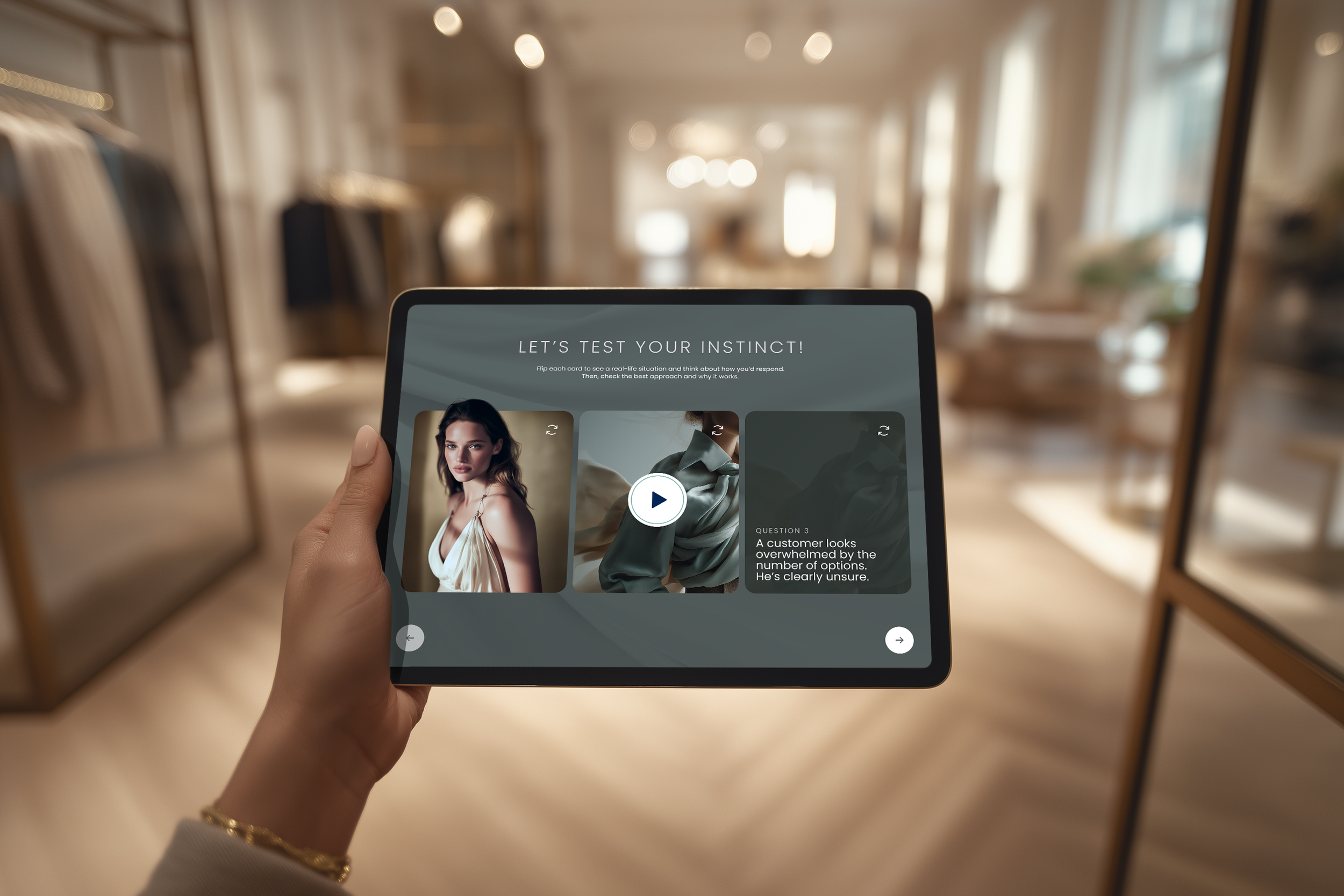
Pre-shift 3-minute ritual: story, one objection line, one ritual reminder.
QR in stockroom: instant access to the exact asset, no searching.
Ambassador demo: tactile walkthrough + one role-play (fast, aspirational, social).
Manager micro-coaching: one observation, one correction, one reinforcement line.
Two live touchpoints: short virtual alignment before launch, short Q&A correction session after week one.
The creative agency’s job is to design assets that are deployable, not only beautiful. If it can’t be used in under two minutes in a real shift, it won’t scale.
Multi-market rollout
Standardize the skeleton, localize the voice.
To protect global consistency while respecting culture:
Standardize:
Story structure, key claims, red lines, service ritual sequence.
Localize:
Tone, politeness level, pacing, objection phrasing, pronunciation guidance.
A creative agency can manage the localization pack (glossary, phrase bank, pronunciation notes) and the review workflow (translation, proofread, brand voice sign-off).
This is where brand integrity is protected at scale.
After-training: capture feedbacks, fix gaps, prove impact
Training is only “launched” when it is reinforced and improved.
Gather unanswered questions twice weekly (“What did clients ask that you couldn’t answer?”).
Create a “Top questions this week” update pack (fast, visible, practical).
Use store performance KPIs to locate gaps, then target reinforcement to low-performing stores.
When this loop is active, training becomes a living system. You stop guessing and start improving based on evidence.
A 30-day operating rhythm
Maintain the performance with a consistent pace:
Days -14 to -8: tactile fluency (hero story, ritual clip, comparisons).
Days -7 to -1: selling ceremony rehearsal (objections, scenarios, micro practice).
Days 1 to 7: daily focus rhythm (one behavior per day, zero friction).
Days 8 to 20: error reduction packs (fix what’s repeating).
Days 21 to 30: mastery (advanced client profiles, confident improvisation).
A creative agency supports this by maintaining cadence, version control, and fast updates.
Tempo is strategy.
How succesful training can be.
A good training product launch looks like calm confidence on the floor. Associates don’t sound memorized, but they sound aligned. They tell the hero story in a clean 30–45 seconds, they handle the top objections without awkward detours, and they execute the service ritual with the brand’s pacing and discretion. Most importantly, the client experience feels consistent across shifts and across stores, even when traffic spikes or stock constraints appear.
From a business perspective, a strong launch leaves fingerprints in the metrics that matter. You should see growth where the product category is meant to grow: higher sell-through of hero SKUs, stronger attachment where styling logic was trained, and fewer avoidable returns linked to misunderstanding (fit, care, expectations). You should also see qualitative indicators improve: better outcomes in mystery visits because service rituals become repeatable, and higher client satisfaction because teams communicate with clarity and confidence. Even when numbers vary by market, the pattern should be visible: the stores that fully adopted the launch rhythm show fewer repeated errors and more consistent storytelling than the stores that treated training as a one-time event.
But the biggest sign of success is what happens after the first wave. A mature launch system doesn’t end when the capsule hits the floor. It keeps listening. It captures unanswered questions, it publishes updates quickly, and it uses store performance signals to focus reinforcement where it’s needed most. Low-performing stores aren’t blamed; they’re diagnosed. Are they missing product facts, language, ritual execution, or manager coaching? The response is precise: one updated objection script, one improved comparison card, one short ritual refresher, plus one manager coaching prompt.
When you close the loop like this, every launch makes the next one easier.
You build a proven plan: a repeatable content kit, a reliable deployment cadence, a localization workflow that protects brand voice, and a measurement approach that turns feedback into smarter creative decisions. That’s the agency value proposition in its strongest form: not just content production, but a system that repeatedly converts launch complexity into store performance, market by market, season by season.
