
Adopt Interactive Video in Beauty Product Training
Turn product knowledge into trust, confidence, and conversion for skin care teams in 2026.
In beauty, training is not just about knowing what a product is. It is about being able to explain why it matters, for whom it works, how to use it, and what to expect over time. Skin care is a trust category. Results are often gradual, depend on routine, and can be influenced by lifestyle, sensitivity, and consistency. That means the client is rarely buying a single formula. She is buying reassurance, expertise, and a believable path from today’s concern to tomorrow’s improvement. When store staff feel unsure, they fall back on generic claims, avoid technical details, or oversimplify. That can damage credibility, increase returns, and reduce long term loyalty.
This is where product training needs a modern upgrade. You still need strong technical knowledge, but you also need delivery that builds confidence fast, keeps attention, and mirrors real client conversations. Interactive video is one of the most effective formats for that job because it combines the emotional power of video with decision making, practice, and feedback. Instead of asking learners to passively watch, it invites them to choose, explore, and respond. It can simulate a consultation, test understanding in the moment, and guide the learner toward the best next step based on a persona, a concern, or a product routine.
Even better, interactive video supports hybrid learning. Teams can practice scenarios digitally, then bring the same logic in store through product presentation, sampling, and coaching. With repetition, short refreshers, and targeted reinforcement, interactive video helps staff retain the details that matter, like key actives, usage rules, contraindications, layering order, and expected timelines. It also supports cross-selling ethically by teaching how to build a routine that makes sense, not a basket that feels forced. In 2026, beauty brands that win are those that make expertise scalable, consistent, and engaging. Interactive video does exactly that.

Beauty product training is about trust
Confidence is the real conversion tool.
Skin care clients are often educated, skeptical, and comparison driven. They research ingredients, watch reviews, and ask detailed questions. When a store advisor answers clearly and calmly, the client relaxes. When the advisor hesitates, the client starts looking for proof elsewhere.
A strong training approach builds three layers of confidence.
First, product confidence. The advisor knows what the product does, how it works, and how to use it correctly. Second, consultation confidence. The advisor can ask the right questions and recommend responsibly. Third, brand confidence. The advisor can explain what makes your brand different without sounding scripted.
Keep these bullets because they directly support trust:
Know the benefits and the usage rules, how much to apply, how often, what not to mix, what to expect in two weeks and in eight weeks.
Learn client language, how to translate technical terms into clear, supportive explanations.
Practice objections, sensitivity, price, “I tried everything,” “I am scared of irritation,” “I want instant results.”
Interactive video works because it trains all three layers together.
What interactive video changes
From passive watching to guided practice.
Traditional video is valuable, but it is still one way. A learner can watch, nod, and forget. Interactive video turns viewing into action. It creates moments where the learner must think, choose, and apply.
In beauty training, that matters because the job is decision heavy. You are constantly choosing how to respond, what to recommend, and how to adapt based on skin type, concerns, age, routine habits, and budget.
Interactive video supports:
Instant knowledge checks, so learners do not carry misunderstandings forward.
Exploration, so a learner can click on a texture, an applicator, or an ingredient highlight and learn more.
Coaching at scale, because feedback can be built into the experience.
This is not about making training flashy. It is about making training closer to real work.
Hot spots for product mastery
Make details memorable without overwhelming learners.
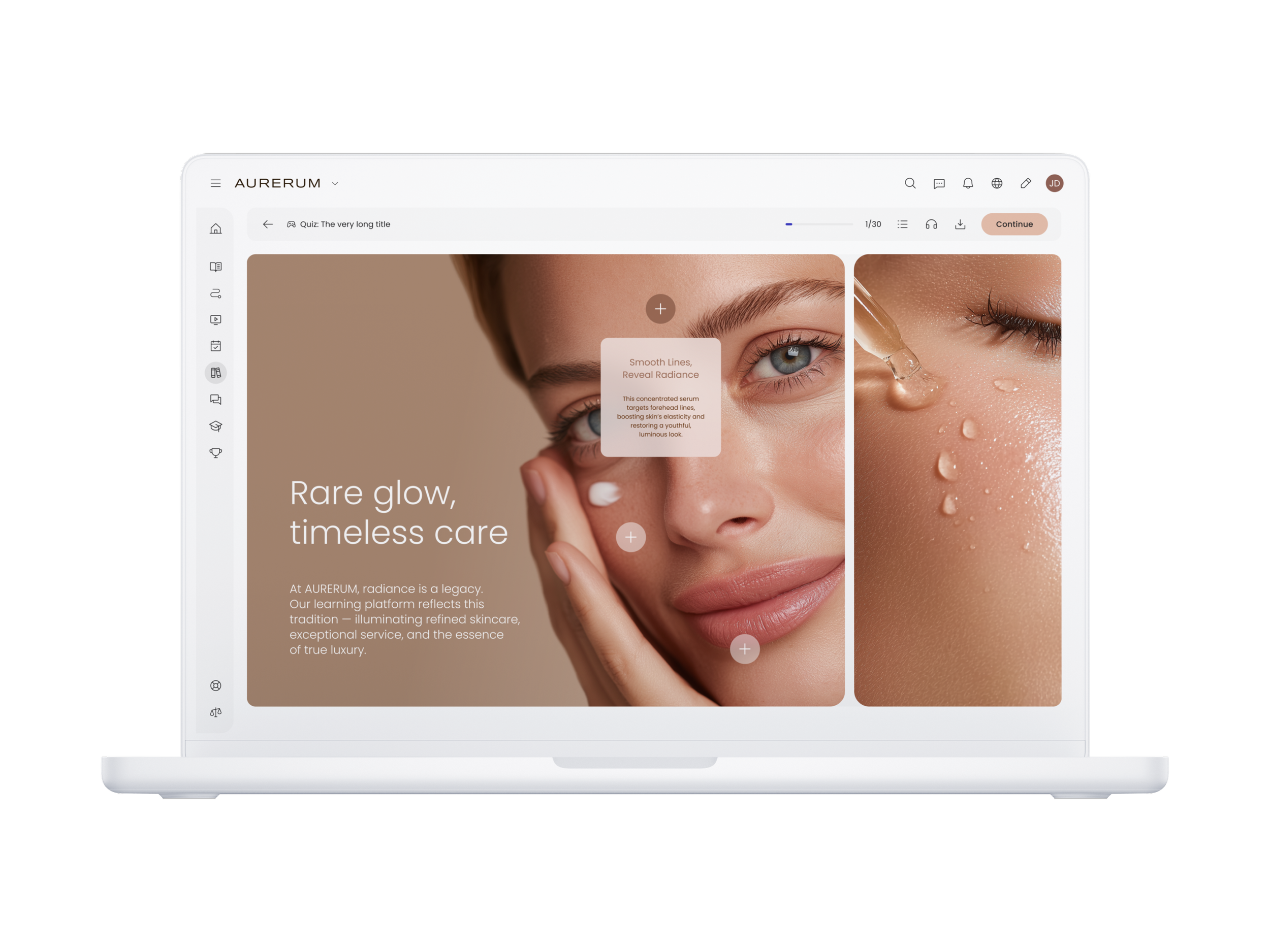
Beauty products are sensory. Texture, finish, fragrance, absorption, layering behavior, and packaging usage are not well taught through text alone. Hot spots let the learner explore what matters at their own pace.
Example use cases for skin care:
Click on the serum texture to learn the best application technique and amount.
Click on a “layering order” icon to see how it fits with cleanser, toner, active, moisturizer, SPF.
Click on an ingredient callout to see what it does and how to explain it simply.
Click on a warning area to learn what to avoid for sensitive skin.
The advantage is precision. You can keep the main storyline clean and reduce cognitive load, while still offering depth for learners who want it. That makes the experience feel premium and professional, which matches the category.
Video quiz for fast confidence
Turn watching into knowledge that sticks.
Video quiz works well in product training because it checks comprehension in the exact moment the concept is introduced. It also makes learners feel progress quickly.
Example questions that match real client interactions:
Which benefit should you lead with for dehydration versus dullness?
What is the correct routine order for an exfoliating active?
What is the minimum expectation you should set for results timeline?
Which phrasing is safer for sensitive skin concerns?
Keep the quiz short and frequent. In 2026 attention is fragmented, especially for store teams. Many small wins beat one big test.
Scenario based learning in video
Train consultations, not just facts.
Beauty advisors are not just selling products. They are guiding decisions. Scenario based learning is ideal because it teaches how to think, not only what to say.
Scenario example 1: The skeptical client
She says she has tried everything and nothing works. The interactive video asks the learner to choose the next move. Ask questions, confirm routine, propose a patch test approach, explain timelines, or push a hero product. Each choice leads to a different path, showing what builds trust and what creates resistance.
Scenario example 2: The sensitive skin client
The learner must decide how to recommend safely. The video reinforces responsible language, suggests a routine approach, and teaches when to avoid overpromising.
Scenario example 3: The gift buyer
The learner practices identifying the recipient profile, then building a set that feels thoughtful rather than random.
These scenarios build a storytelling around the client that feels relevant and answers her questions. When training mirrors reality, adoption increases because learners immediately see usefulness.
Video assessment for service quality
Measure readiness without turning it into pressure.
Video assessment can evaluate decision making and consultation quality in a consistent way. It is especially useful for onboarding, new launches, and seasonal campaigns.
What you can assess:
Product recommendation accuracy for a persona.
Safety and responsibility in claims and language.
Ability to cross-sell as a routine, not as a push.
Ability to explain benefits clearly and confidently.
To keep it motivational, position it as development. Use constructive feedback and allow retakes. The goal is progression, not punishment.
Hybrid learning: digital scenarios, in store experience
Repetition that turns knowledge into habit.
Interactive video is powerful, but beauty is physical. The best results come from a hybrid environment where digital practice is followed by in store experience.
A practical hybrid loop:
Digital pre work: interactive video scenario about a client concern.
In store practice: product presentation and sampling, then a short role play.
Manager coaching: one feedback point, one improvement target.
Refresh: a short interactive recap a few days later.
This creates repetition without boredom. It also supports spaced learning, which matters in a category with many SKUs and constant launches.
Keep only these bullets because they are operationally realistic:
One digital module per week, short and focused.
One in store practice ritual, five minutes before peak hours.
One refresher asset, micro and mobile friendly.
Personalised learning with personas
Recommend the right routine to the right audience.
Beauty selling is matching. Personalised learning makes training feel relevant because it adapts to role, store type, and client profile.
Use personas that reflect your real clientele:
The first time skin care buyer who wants simple steps.
The ingredient savvy client who asks about actives and concentrations.
The busy professional who wants fast routines.
The sensitive skin client who fears irritation.
The luxury client who values experience and ritual.
Interactive video can ask the learner to choose a persona, then guide the recommendation flow. This teaches both empathy and technique. It also improves confidence because learners practice in a safe environment before facing the client.
Cross-selling that feels ethical and premium
Build routines, not baskets.
Cross-selling in skin care should feel like a coherent plan. Interactive video can teach how to suggest more than one product to the lead without losing trust.
A premium cross-sell logic:
Lead product solves the main concern.
Support product improves comfort and adherence, for example barrier support or hydration.
Protection product prevents setbacks, usually SPF.
Optional booster addresses secondary concerns.
The training must also teach when not to add more. Sometimes the best advice is to simplify. That honesty is what builds loyalty.
Short interactive exercises can reinforce this:
Choose the best two product routine for a persona.
Identify which add on is unnecessary and why.
Practice language that frames recommendations as a routine journey.
Gamification that makes training interesting
Motivate without distracting.
Gamification is relevant when it supports the learning culture and store results. In beauty, you can align it with campaigns, launches, and service priorities.
What works well:
Weekly missions tied to a consultation behavior, not just completion.
Team challenges linked to product knowledge and service excellence.
Recognition for consistency, helping peers, and improvement.
Avoid gamification that rewards speed over quality. You want confident advisors, not fast clickers.
Making it adoptable for store teams
Communication and manager involvement are still the engine.
Even the best interactive video will fail if the rollout is weak. Adoption needs a communication strategy that respects store reality.
What to do:
Explain why the training matters now, tie it to campaigns and client needs.
Set a clear weekly rhythm, what to do, when, and how long it takes.
Ask for feedback and adjust based on obstacles.
Make managers participate, discuss scenarios, and coach on the floor.
When store managers and retail excellence teams engage, learners follow. Training becomes part of professionalism and pride.
Adopting interactive video in beauty product training
It’s ultimately about protecting and amplifying what makes skin care a premium category: trust, expertise, and a credible experience. Clients do not just want a product. They want to feel understood, safe, and guided. Because results can take time, the advisor’s ability to set expectations and explain benefits with confidence is often the deciding factor. When training fails, teams default to vague claims or avoid technical questions, and the client’s trust shifts to online opinions, competitor messaging, or price comparisons. When training succeeds, the client feels supported and returns for the routine, not only for the first purchase.
Interactive video is not a trend. It is a practical solution to a real beauty challenge: training must build trust, confidence, and consistent consultation quality at scale. The format is engaging, but the real value is deeper. It trains decisions, not just facts. It supports repetition and hybrid practice. It helps advisors match products to personas, cross-sell ethically through routines, and tell a story that feels personal.
Interactive video offers a modern way to build that expertise without overwhelming store teams. It turns learning into action through choices, exploration, and feedback. Hot spots help learners master textures, usage techniques, and key ingredients in a way that feels intuitive and premium. Video quiz moments make knowledge stick in small, manageable steps. Scenario based learning teaches what matters most in beauty retail, how to respond to real concerns, how to recommend responsibly, and how to build a routine that fits the person in front of you. Video assessment strengthens consistency and service quality, especially for onboarding and launches, while still supporting motivation when positioned as development rather than judgment.
The strongest results come when interactive video is part of a hybrid strategy. Digital practice prepares the mind. In store experience builds the skill. Manager coaching and repetition create the habit. Add thoughtful gamification and personalised learning paths, and you create momentum that feels earned, not forced. Most importantly, you create a culture where learning gives something back: confidence, professionalism, stronger results, recognition, and growth opportunities.
In 2026, beauty brands that scale retail excellence will be the ones that train for real conversations, not for content completion. Interactive video is one of the most effective ways to do that, and to make product training feel as modern and premium as the products themselves.
