
How to implement storytelling in luxury retail training
Storytelling is one of the most effective ways to convey luxury brand culture, as it transforms product knowledge into a narrative that sales advisors can recount with confidence, adapt to different clients and apply in real-life conversations.
Research on luxury brand narratives shows that narrative transportation (when people become absorbed in a story) leads to stronger engagement with luxury brand communication, which is exactly the effect that retail training will need in 2026 when people's attention is fragmented and learning time is limited. Furthermore, research in learning contexts shows that story-based/storytelling-narrated formats can improve retention compared to more lecture-style delivery. This supports the idea of storytelling as a practical performance lever rather than a 'soft' creative add-on.
Storytelling establishes a shared brand language across stores, ensuring a consistent experience worldwide.
It enables advisors to justify value without sounding scripted or defensive about price.
It transforms 'heritage' into something that is relevant to clients' current identities and lifestyles.
It provides head office with a repeatable structure for training seasonal drops, icons and campaigns on a large scale.

Why storytelling sells and trains
Luxury items are rarely purchased solely for their functionality; they are purchased for their ability to convey identity, evoke emotion and reflect culture.
Training that stays at the 'spec sheet' level creates sales advisors who sound knowledgeable but not compelling. Storytelling training builds confidence because it provides teams with a narrative structure that they can use in client conversations, rather than just facts to memorise.
If the purpose of luxury retail is to make clients feel something, then training must teach teams how to consistently create that feeling at scale and in every store.
Story led retention, not fact overload
This year, retention means Sales Advisors can recall the story and apply it to real-life situations and different client profiles. Research on digital storytelling suggests that story-narrated formats can improve retention and application compared to more 'lecture-like' delivery. This makes storytelling a smart design choice for retail teams who are short on time.
What “good retention” looks like in luxury retail training:
Sales advisors can justify the value of products without offering discounts.
They can handle objections using story logic (craft, scarcity, expertise and care).
They can personalise their approach without improvising randomly by using a structured narrative that adapts.
Storytelling is also easier to reinforce because you can refresh one scene, one line, one detail card, and the whole narrative becomes vivid again.
1. Craftsmanship storytelling
A good craftsmanship story helps advisors to translate invisible values such as time, know-how, precision, rarity and finishing into something that clients can visualise and appreciate without being overwhelmed by technical terminology.
This is why luxury retail storytelling is often described as a strategic narrative tool that can captivate and engage while remaining true to heritage and tradition. It's exactly the balance that a sales advisor must deliver in person in a matter of seconds with elegance and clarity.
A structured “craftsmanship story” template:
Origin: Where does the technique/material come from (place, atelier, expertise)?
Process: What happens that is different from standard production (key steps, time, precision)?
Proof: What detail can be shown physically (stitch, finish, weight, sound, texture)?
Benefit: What the client gains (feel, durability, comfort, exclusivity, emotion).
Care: How to preserve it (ritual, after-sales, longevity).
Craftsmanship stories should always end with a “show moment”, a gesture, a detail, a comparison, it's because luxury value becomes believable when it is seen and touched, not only described. A good rule: if the story can’t be demonstrated in the client’s hands, simplify it until it can.
2. Heritage storytelling
Heritage is powerful in luxury, but only when it functions to build trust, not as trivia. When training, heritage must answer one question:
“Why should a client believe in this brand?”
Multiple Researches discussing luxury narratives highlights how storytelling can position brands as cultural agents and deepen engagement through immersive experiences. These experiences can be translated into learning design through the use of scenes, characters, rituals and iconic codes. When executed effectively, heritage storytelling empowers Sales Advisors, enabling them to speak with calm conviction as the narrative transcends the product in front of them.
3 heritage angles that consistently work in client conversations:
The icon: a signature piece that represents continuity (and why it still matters now).
The codes: recognizable elements (shapes, motifs, materials) that signal authenticity.
The milestones: one or two key moments that explain the house’s point of view.
Heritage is at its most powerful when it supports a client’s self-image, so training should include discovery prompts to help advisors connect brand codes to client identities. If heritage cannot be linked to a client’s lifestyle or values, it risks sounding like a museum tour.
3. Clienteling storytelling
In 2026, clienteling is not just about having data; it's also about using it tactfully, humanely and in a way that is consistent with the brand.
Storytelling scales up clienteling because it provides Sales Advisors with "story modules" that they can assemble depending on the individual customer: a discovery story to open the conversation, a proof story to build confidence, and a future story to establish continuity after the visit. Industry writing on luxury clienteling emphasises long-term relationships, hyper-personalised experiences, and insight-driven engagement. Storytelling is the bridge that turns these principles into real boutique dialogue instead of generic scripts.
A practical clienteling story flow for training scenarios:
Discovery story: ask questions that reveal lifestyle, usage, preferences.
Curation story: propose 2–3 options as a “edit,” not a list.
Proof story: demonstrate details that match the client’s values.
Future story: connect to next steps (care, styling, gifting, occasions, follow-up).
The goal is not to “tell a story at the client,” but to co-create a story with them. Training should teach listening cues, mirroring language, and the ability to pivot the narrative without losing the house tone.
4. eLearning formats that value stories
Storytelling only works on a large scale if the content format matches real retail situations.
In 2026, luxury retail trainings teams need to apply these two approaches:
Immersive learning for training purposes and ultra-fast recall for client meetings.
Research indicating that learners benefit from story-narrated formats supports the investment in short narrative videos and scenario-based assets, as these help learners to remember not just facts, but also the phrasing, tone and sequence of actions.
Course assets that work well:
Scenario video: a boutique scene with a client, an objection, and a resolution.
Audio micro-coaching: “how to say it” in the right tone or native pronuonciation.
Interactive branching: choose the next line, then see consequence.
InstaLearning cards: 15–45 seconds, one fact + one client sentence + one detail to show.
The more reusable a story asset is in real selling situations, the more the platform becomes part of daily work, and the higher the levels of both retention and adoption. If an asset cannot be used on the shop floor, convert it into a shorter InstaLearning card or a scenario snippet.
5. Measurement and reinforcement
Storytelling training must be measurable; otherwise, it remains in the 'nice content' category and is cut when priorities change.
The most effective approach is to treat stories as living product assets: publish them, observe how they are used, capture any questions that arise, and then update the content based on what is actually happening in stores. Using learning analytics alongside store observation and data performances (e.g. completion, replay and quiz performance) helps to identify which narratives are effective, which objections are arising and where advisors need reinforcement.
The main KPIs to keep track of are:
Learning: completion rate, average score and replay rate on scenario videos.
Confidence: quick polls ('I can tell the story in 60 seconds').
Behaviour: manager observation checklist (tone, steps, objections).
Data performance : conversion rate for the featured category, attachment rate (UPT/ATV) and sell-through rate for focus items.
Reinforcement ideas that keep stories “fresh”:
Weekly InstaLearning: new angle on the same hero story.
Objection update: add one new branch when stores hear a new objection.
Micro-certifications: short refresh tests after campaign phases.
When stories are treated like living assets, updated, reinforced, and measured, the training becomes a performance system that protects brand consistency and improves the client experience. Over a season, this creates a measurable loop:
better stories → stronger advisor confidence → better client conversations → clearer store outcomes.
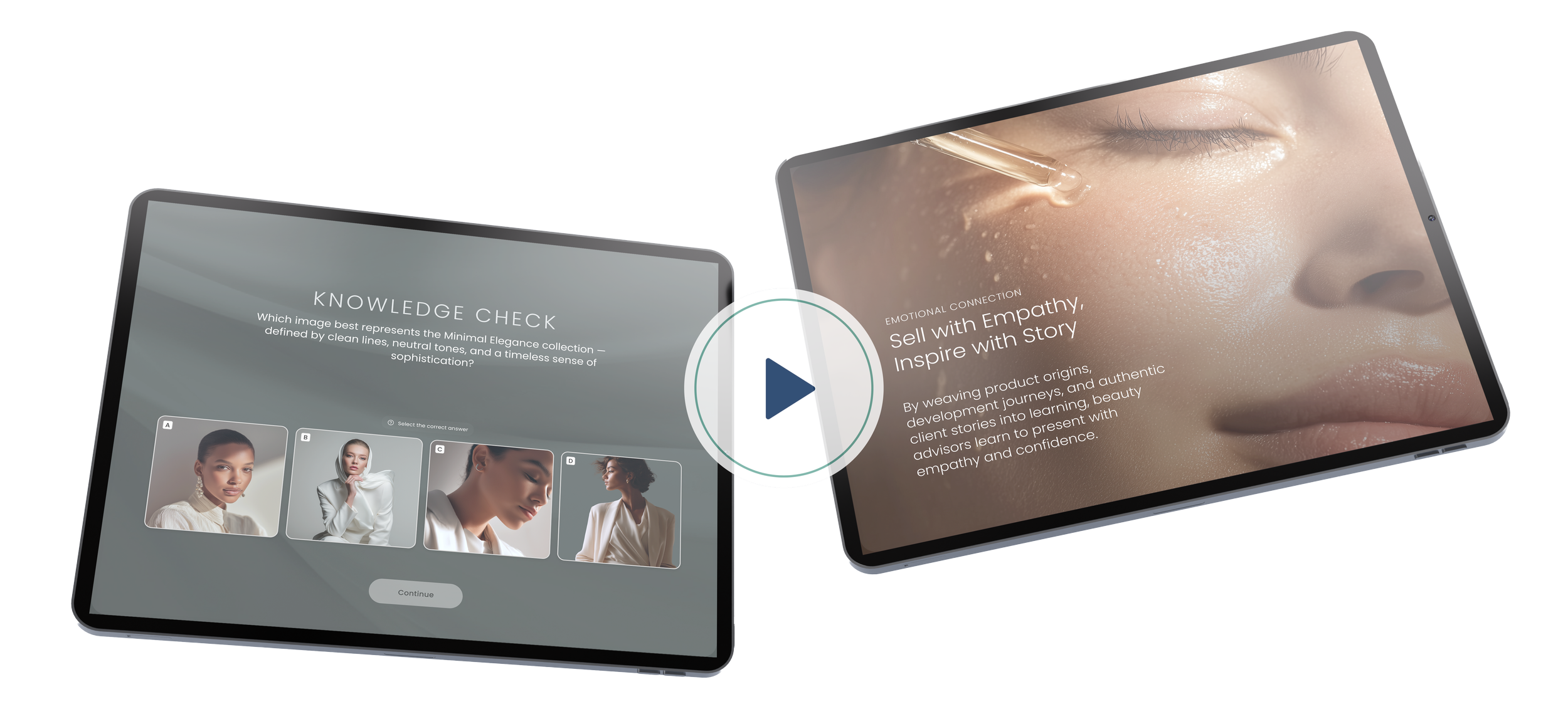
The structured approach for luxury training teams
A luxury retail company doesn't need sales advisors who simply regurgitate facts.
What it needs are advisors who can consistently translate the company's culture into confident, client-ready language across every store and market. Storytelling is the most effective way to develop this skill because it provides teams with a structure that remains effective under pressure: a beginning that generates curiosity, a moment that provides proof and feels credible, and a conclusion that invites clients into the brand's world without being pushy. When this structure is mastered, advisors sound prepared, not scripted.
The most effective storytelling training programme incorporates three key elements:
Craftsmanship: this is not a technical lecture, but rather a narrative that highlights the invisible aspects of time, precision and expertise, making them tangible through a single detail that the client can see or touch.
Heritage: not a timeline, but reasons to trust the brand's current values, icons and milestones that connect with the client's identity rather than the brand's ego.
Clienteling: not 'data usage', but personalisation with tact, discovery questions that reveal lifestyle, curation that feels like an edit, proof that matches what the client values and a future story that naturally leads to follow-up.
In order to operationalise storytelling in 2026, the format is as important as the words. Stories should be built in short, mobile-first assets such as scenario videos, interactive branching dialogues, audio micro-coaching for tone and InstaLearning cards that can be checked in seconds before a client appointment. Then keep the stories alive by measuring replay behaviour, quiz outcomes, confidence signals, manager observations and the store-level proxies that matter.
Reinforce weekly, refresh when objections evolve and treat each story as a product that improves with use. This is how brand culture becomes consistent behaviour, and how training becomes a real driver of selling confidence.
