
Top 8 Factors to Evaluate When Upgrading Your LMS
Planning Your LMS Upgrade: 8 Features That Matter
Choosing a new LMS is no longer just a technical choice—it shapes how your organization learns and grows.
A strong platform affects the speed of learning, the adaptability of training materials, and the control your brand has over the user experience and budget.
Many teams consider a new LMS when their current system feels slow or outdated. The real challenge usually lies in flexibility: the ability to create relevant content, offer personalized learning, support mobile learners, and scale as the organization evolves.
Treating a new LMS as a strategic tool rather than just a replacement ensures it builds on existing successes, fixes pain points, and opens doors to future training opportunities, including analytics, AI-assisted learning, skills visibility, and content scalability.
Here are eight key features to examine before switching. Some ensure a smooth transition, while others ensure the platform stays effective long-term.

1. Creating a Tailored Learning Environment
Control over your learning experience is essential.
The ideal LMS gives your team the ability to shape the platform to match your organizational identity and internal culture. A platform that can be fully branded encourages learners to see training as part of the core organizational journey, not an isolated task.
White label functionality helps drive engagement, adoption, and consistency across all learning initiatives.
Points to evaluate when assessing an LMS:
Can you adjust the platform’s visual design, terminology, and navigation to fit your brand?
Can the system handle different groups or regions without losing a cohesive experience?
Can your internal team make changes independently, without technical delays?
An LMS should flex around your training goals and growth strategy. If customization is limited, even a modern-looking system can become a constraint.
Leading platforms in 2026 combine adaptability, branding readiness, and flexibility, making them a long-term partner for your learning programs.
2. Seamless Content Migration for Learning Continuity
One of the biggest pitfalls when switching LMS platforms is treating content migration as an afterthought.
Migration is the critical moment that determines whether the transition feels smooth, disruptive, or unnecessarily complicated.
Moving to a new platform usually involves more than just transferring course files. It may include learner records, permissions, course structures, reporting history, certifications, media libraries, assessments, and workflows. If these elements aren’t carefully mapped, the new LMS can start with confusion rather than momentum.
Key points to review before making a move:
Which learning content should be migrated as is, redesigned, or retired?
How will user data, roles, and permissions be handled?
Does the provider offer structured onboarding, administrative training, and technical support during the launch?
Can reporting continuity and certifications be preserved where needed?
Migration is also an opportunity to improve quality. Outdated visuals, duplicated modules, weak mobile performance, or unnecessary complexity can be addressed during the transition. A strong LMS upgrade doesn’t just move content—it enhances the entire learning ecosystem.
A vague migration plan is a warning sign. Effective LMS transitions require clarity, structured content logic, and real support—not just a promise that files can be imported.
3. Mobile-First Learning Designed for Real-World Use
An effective LMS should meet learners where they are.
Increasingly, learning takes place on mobile devices—quickly, across multiple environments, and often outside of a fixed setting.
Mobile capability is no longer optional. It plays a central role in making training accessible, flexible, and aligned with real workflows.
What to review before making a decision:
Is the LMS designed primarily for mobile use rather than adapted for it?
Does content display and function well across smaller screens?
Are short, focused learning formats supported?
Can learners access content offline when needed?
A mobile-first approach encourages consistent engagement. When learning is easy to access in real time, it becomes part of everyday activity rather than a separate task.
Platforms that overlook mobile design risk falling behind how elearning is actually consumed today.
4. From Content Hosting to Content Creation
An LMS should do more than store learning materials—it should help create them.
Built-in authoring tools are essential for keeping pace with constant change. As priorities evolve and new learning needs emerge, teams must be able to update content quickly and efficiently.
Modern platforms offer flexible authoring features, including multimedia support, interactive modules, assessments, reusable templates, and structured workflows. These capabilities allow teams to maintain consistency while adapting content for different audiences.
Consider the following when reviewing a platform:
Ease of use for non-technical content creators
Availability of reusable, brand-aligned templates
Support for interactive training experiences
Built-in content reuse to improve efficiency
Templates are particularly powerful within systems like The Learning Lab, helping standardize design while enabling faster rollout of new content.
A well-equipped LMS reduces reliance on external resources and enables continuous content evolution, making elearning more responsive and effective.
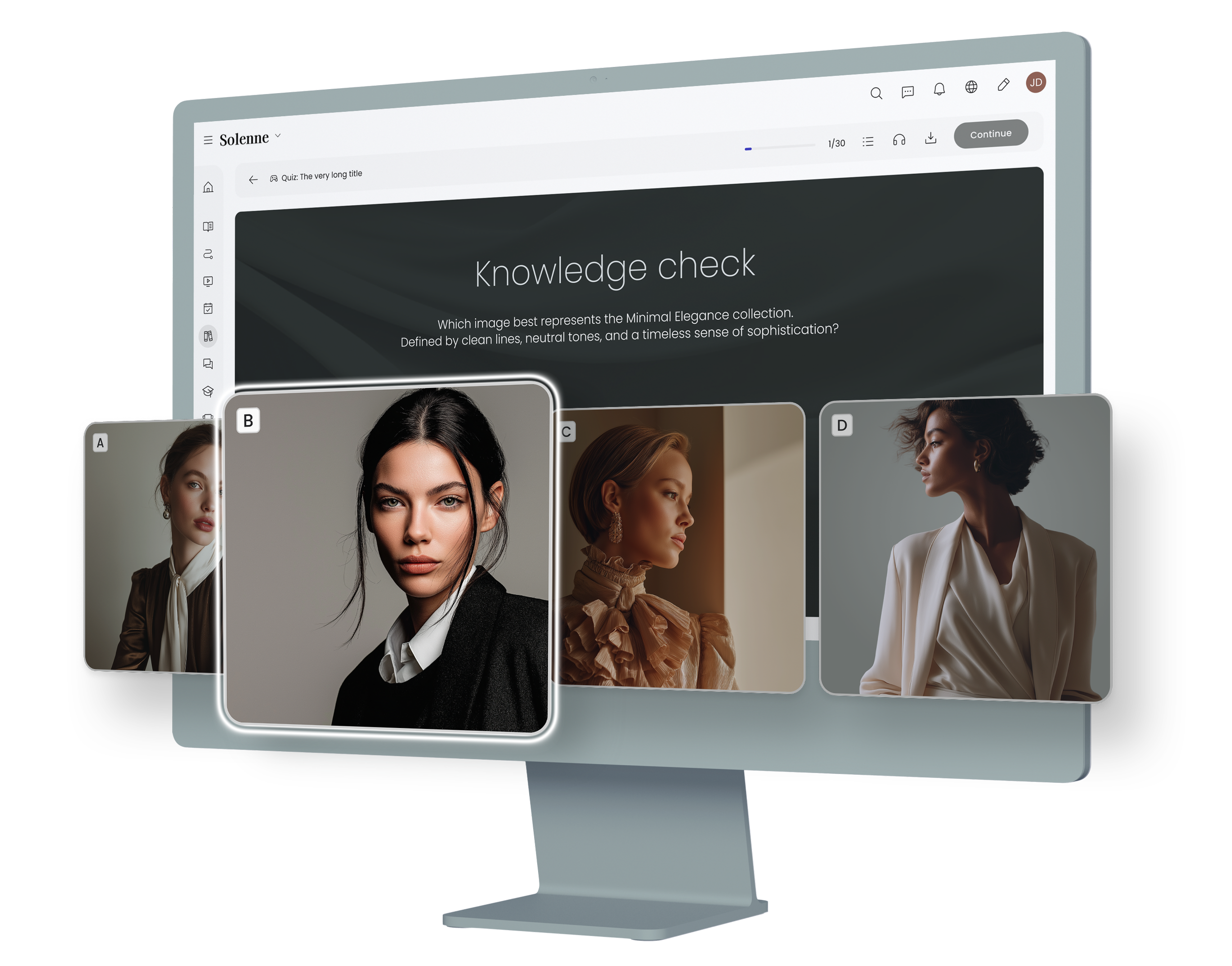
5. Balancing AI Efficiency with Human Expertise
AI is now a prominent feature in modern LMS platforms.
But the key question is not its presence—it’s its value. Effective AI should enhance how training is created, delivered, and improved.
Today’s LMS platforms use AI to assist with content drafting, summarization, translation, recommendations, and personalization. Many also integrate AI with analytics to create more adaptive elearning experiences.
Even so, human input remains critical. Quality, tone, pedagogy, and brand consistency cannot be left entirely to automation. Human review ensures that learning content is accurate, relevant, and appropriate for its audience.
When evaluating AI capabilities, ask:
Does AI support practical, everyday workflows?
Is there a clear role for human quality control?
Does the system prioritize meaningful, relevant learning experiences?
Does your team maintain control over final outputs?
AI works best as a partner. It enhances speed and efficiency while leaving strategic and creative decisions in human hands.
6. Adaptive Learning Journeys and Global Accessibility
A one-size-fits-all approach no longer works in modern learning environments.
Today’s LMS platforms are expected to deliver personalized elearning experiences that reflect individual roles, goals, and contexts.
Adaptive learning paths, multilingual delivery, and clear progress tracking are key components of this approach. Together, they create structured yet flexible journeys that support continuous development.
What to evaluate:
Role-specific pathways that guide learners toward relevant outcomes
Multilingual delivery with accurate review and contextual adaptation
Certification systems that recognize achievement and progress
Learning journeys that combine core requirements with suggested next steps
For international audiences, localization is essential. It ensures that content is accurate, culturally appropriate, and aligned with your brand.
Personalization signals a shift from static content delivery to dynamic learning experiences—making the LMS more effective and learner-focused.
7. Measuring Impact and Driving Engagement in Learning
An LMS should do more than deliver content—it should reveal impact.
Insight into learner behavior, progress, and skill development is essential for understanding how effective your elearning strategy truly is.
Today’s platforms place greater emphasis on analytics and engagement. Features like interactive content, social learning, and gamification not only improve participation but also provide deeper insight into how learners interact with training.
When reviewing a platform, consider:
Whether analytics provide meaningful insight into learner behavior
How skills are tracked and connected to learning paths or certifications
The availability of engagement tools that encourage active participation
Whether reporting supports ongoing improvement and decision-making
A platform without strong analytics limits visibility and impact. With the right tools, an LMS becomes a source of insight—not just delivery—helping teams continuously refine their approach.
8. Planning for Long-Term Value and Scalability
Pricing should never be viewed in isolation.
When selecting an LMS, the real consideration is long-term value—how well the platform scales and adapts as your training needs evolve.
Modern elearning platforms often include additional costs beyond subscription fees. These may involve onboarding, integrations, customization, support, and ongoing content development. Flexible pricing models can help manage these costs, provided they align with changing usage and growth.
Key areas to assess:
Pricing structure and how it scales over time
Additional costs for onboarding, migration, and support
Integration with existing tools and workflows
Ongoing investment required for content updates and localization
A platform that appears cost-effective at the start may become restrictive later. In contrast, a scalable LMS supports efficiency, reduces dependency, and adapts without major disruption.
Long-term success depends on choosing a system that balances cost with flexibility and sustainability.

Rethinking the LMS Transition
Switching to a new LMS should be seen as a growth decision—not just a system replacement.
The most effective transitions happen when organizations move beyond comparing feature lists and start focusing on which capabilities truly create more flexibility, speed, and long-term value.
This shift changes the selection process entirely. Instead of choosing a platform that simply delivers courses, the focus turns to finding one that supports brand alignment, protects content during migration, works seamlessly on mobile, enables faster content creation, uses AI thoughtfully, personalizes training, provides visibility into skills, and scales efficiently.
It also encourages a more practical view of what an LMS should deliver. A strong platform reduces complexity rather than adding to it. It helps teams move faster, makes elearning more relevant, and provides clear insight into engagement and progress.
Learner expectations continue to evolve. Users now expect intuitive mobile experiences, relevant recommendations, shorter formats, strong localization, and content that stays current. At the same time, organizations need better cost control, easier updates, and systems that grow alongside their needs.
The right LMS is not defined by the number of features it offers, but by how well those features work together. When flexibility, usability, quality, insight, and scalability are aligned, the transition becomes a meaningful step forward—improving both learning outcomes and overall performance.