
The Evolution of Workplace Learning
When the Environment Changed, Not the Method
The original method did not disappear — it adapted to a new environment.
For years, organizations developed people through hands-on practice, even without formally labeling it as “learning design.” A senior team member guiding a colleague, a leader refining a client interaction, a rehearsal before a major campaign, a story repeated until it flows naturally. These approaches are not outdated. They are experiential learning in its purest form: practice, feedback, repetition under real conditions.
What shifted over the past decade was not the method, but the context. Smartphones transformed the workplace into a constant information space. Short pauses became learning moments. Video became a universal language. Now, early AI tools are accelerating content creation and personalization, generating scripts, simulations, translations, and variations at scale.
The risk is clear: when content becomes easier to create, organizations tend to create more — not necessarily better.
The result? Overloaded teams, inconsistent storytelling, and training that appears modern but fails to elevate the Brand experience.
The opportunity is equally clear. Digital tools can now scale what traditional approaches did best — without removing the human dimension. Through elearning, supported by an LMS and structured within The Learning Lab, organizations can deliver the right scenario, at the right time, for the right role, in the right language. Expert knowledge can be captured and distributed in concise, practical formats aligned with daily workflows.
But this only works if elearning is treated as a content discipline — not simply a platform initiative.
Recent research highlights an important insight:
Peer-to-peer learning rated very effective at 64%.
Coaching or mentoring at 61%.
Organization-recommended online learning rated very effective by only 38%.
Digital is not failing. It succeeds when it mirrors what works best: peer-driven, practical, timely, and connected to real responsibilities.
Passive vs Practiced
The real divide isn’t old-school versus new-school. It’s passive versus practiced.
The difference is not classroom versus mobile. It’s whether people actively rehearse decisions and receive feedback — or simply absorb information and hope it sticks.
Passive learning: Long documents. Extended modules. Generic quizzes. One-time workshops.
Practiced learning: Scenarios. Role-plays. Coaching. Observation. Repetition under real conditions.
In high-expectation environments, a single sentence can influence trust. That makes practice essential, not optional.
If training does not create repeatable behavior in real interactions, it isn’t training — it’s communication. Communication informs. Practice transforms performance.
Why Simulations Feel New (Even When They’re Not)
Simulations feel innovative, but the method itself is not new.
Rehearsal, case discussions, guided observation, and apprenticeship models have existed for decades. What changed is scale. Digital delivery made practice repeatable, measurable, and easier to integrate into real workflows.
A scenario can now be replayed multiple times before a work period begins. A short video can demonstrate pacing, tone, and behavioral nuance more consistently than written instructions. A branching module can reveal consequences immediately — without risking a real interaction.
Recent workplace research on branching scenarios reinforces this shift. Learners show stronger engagement when situations feel realistic and directly tied to their responsibilities. Decision-making paired with immediate feedback encourages deeper reflection. However, overly complex or repetitive modules quickly reduce perceived value.
Simulations are not a trend. They are structured practice — distributed more effectively. The real creative challenge is keeping them realistic, concise, and consequence-driven.
What High-Expectation Environments Must Develop
The experience is the offering.
In premium environments, people are not simply choosing an item. They are choosing reassurance, identity, and trust.
Prioritize development in:
Language under pressure: openings, transitions, handling concerns, confident conclusions.
Rituals: presentation standards, etiquette in shared spaces, packaging moments, follow-up continuity.
Composure: knowing when to speak, when to pause, and when to shift from storytelling to solution.
Avoid overdevelopment in:
Overly detailed technical lectures that never surface in real dialogue.
Polished campaign phrasing that sounds refined but feels unnatural in live interaction.
Knowledge quizzes that reward recall rather than judgment.
Exceptional training is not about knowing more facts.
It is about performing with calm precision and consistent Brand expression — especially during peak moments.
Design Learning Around Real Situations
If learning is built around situations, performance improves.
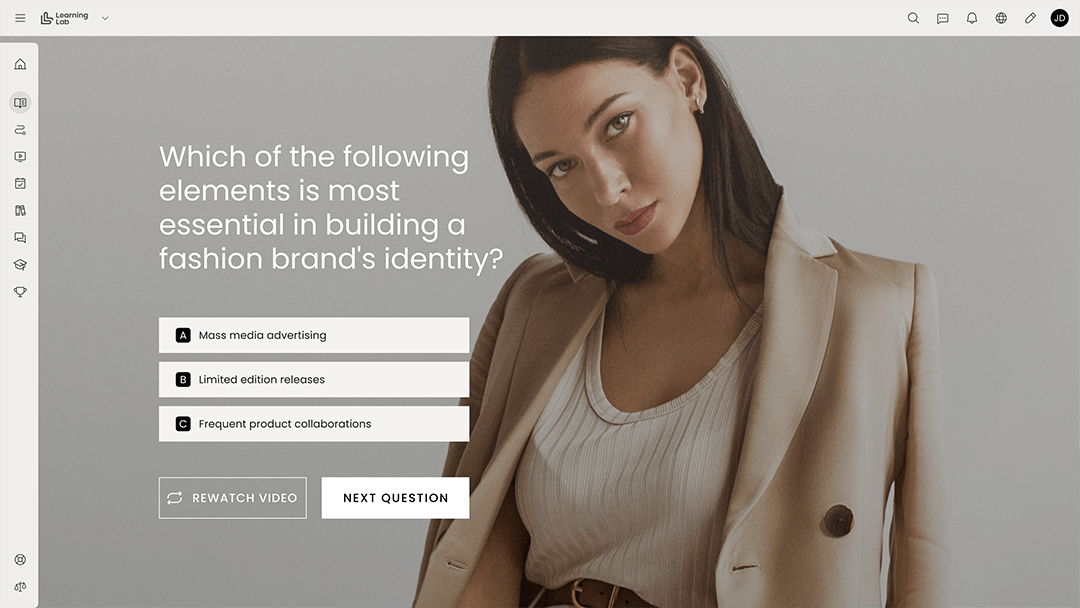
Digital formats should simulate live moments. Think rehearsal, not content consumption. A simple structure works best: two short-form video types and one interactive pathway.
Scenario Video
A focused 20–40 second clip capturing a single turning point — value hesitation, comparison dialogue, or continuity questions.
The learner:
Speaks the response aloud
Mirrors the rhythm
Rehearses the pause
Attach a micro-checklist:
Delivery
Precision
Alignment with Brand standards
Interactive Branching
3–5 decision points.
2–3 possible responses per point.
Each selection triggers immediate outcomes:
Confidence elevated or reduced
Next step advanced or stalled
Feedback clarifies reasoning, reinforcing judgment rather than memorization.
Evidence indicates that scenario-based learning drives engagement when it feels authentic and directly connected to real responsibilities. Immediate consequence-based feedback strengthens thinking. Overly layered modules dilute impact.
Digital creates value when it strengthens instinct and language fluency — not when it adds complexity.

Turning Expertise into Scalable Capability
Experts already exist inside the organization.
The opportunity is to transform their experience into repeatable, usable assets. The formula is simple: capture, craft, refine, and reuse.
Capture
Document the most frequent questions from the past week — along with the strongest real responses. Focus on what actually happens in conversation.Script
Convert raw answers into short, spoken lines. Write for dialogue, not documentation. Keep the rhythm natural and aligned with Brand voice.Film
Produce micro-scenes that reflect correct pacing, tone, and nonverbal cues. Keep each clip focused on one decisive moment.Package
Break content into modular pieces:One story clip
One objection response
One comparison explanation
One ritual behavior
Iterate
Update continuously based on recurring questions and observed performance gaps.
When content is designed for reuse and refinement, every new cycle becomes faster and more consistent. The content pipeline itself becomes a strategic advantage.
Human Reinforcement Drives Performance
Digital tools — whether delivered through elearning or an LMS — expand reach. But human coaching transforms repetition into refinement.
Data referenced by 360Learning shows a consistent pattern: learners value peer-driven learning (64%) and mentoring (61%) significantly more than passive formats. Practice works best when someone is watching, guiding, and adjusting.
Simple structures that match operational reality:
Pre-start rehearsal
One realistic scenario. Immediate feedback.Daily behavior spotlight
Observe one action and correct it precisely.Two-minute debrief
Clarify what worked, what didn’t, and what will change.
Sustained excellence is not protected by information checks. It is protected by coaching discipline — small, daily reinforcements that preserve Brand rituals under pressure.
The Hybrid Loop — Prepare, Perform, Refine
One scenario. Two channels. One standard.
The strongest model is not digital or physical — it is cyclical. Digital prepares. On-site observation validates. Feedback sharpens the next release.
Digital rehearsal
Short scenario practice before or between client moments. Focused repetition. Immediate self-check.Physical validation
A manager observes the same skill live and confirms whether it meets Brand expectations.Feedback loop
Unanswered questions and recurring errors become next week’s updated scenario.
Insights from 360Learning highlight that time and scheduling remain major barriers. Learners consistently prefer development that happens in the flow of work rather than in scheduled blocks.
The hybrid model solves for reality: it respects operational constraints while protecting consistency across locations, teams, and shifts.
Scaling Global Standards with Local Nuance
Organizations need one standard — but execution must feel authentic in each market.
Standardize:
Scenario structure: context, objective, constraints, guiding principle, success criteria.
Red lines: what must never change, what ensures Brand consistency.
Localize:
Language choices, etiquette, and pacing.
Regulatory or operational requirements.
Pronunciation of specialized terms in media or videos.
By localizing the surface while protecting the principle, you achieve global consistency without losing human credibility.
The Modern Learning Engine: Rehearse, Coach, Refine
High-performing organizations don’t debate old methods versus new. They focus on how people learn through action, not just exposure.
Training works when it builds behavioral muscle memory, reinforces Brand standards, and evolves with each cycle.
Digital rehearsal extends reach.
Short-form scenarios, micro-videos, and branching exercises let learners practice critical moments in small, realistic windows. They don’t just observe — they respond, make decisions, and see consequences instantly. Realism and clarity matter more than length or complexity.Coaching bridges theory and execution.
Managers validate one behavior at a time through brief, focused observations and debriefs. Peer learning and mentoring remain the most impactful forms of development, ensuring that rehearsal translates into reliable performance under pressure.Feedback drives evolution.
Every question, hesitation, or error feeds the next iteration of content. High performers contribute best practices. Teams that struggle provide diagnostic signals. Over time, the organization builds a richer library, where every launch, seasonal initiative, or program starts stronger than the last.
The result is measurable and strategic:
Consistent behaviors across teams and markets
Fewer repeated mistakes in everyday situations
Faster readiness during peak periods
Stronger alignment with Brand standards and client experience
Modern learning isn’t a trend. It’s a repeatable, scalable system that turns expert insight, digital rehearsal, and coaching into an engine for continuous improvement — ensuring every next cycle is smoother, more consistent, and more effective.